
MFour’s Growth Continues with Hiring of Three More Quality Assurance Experts

Posted by admin on Mar 16, 2017 2:32:19 PM


new hire 900x300


MFour has hired three new quality assurance specialists to support ongoing innovations in mobile survey technology, and to ensure its ever-growing client roster enjoys efficient and consistently effective research experiences.


Michael Mullen joins as a Quality Assurance Engineer, with duties that include testing and developing systems to drive consistently superior technical performance. He arrives with a background in systems testing and tech support, including a recent software engineering position at Barracuda Networks. Hockey, gaming, and hiking are Michael’s leisure-time favorites.


Richard Tsu will support testing of MFour’s systems as a Quality Assurance Analyst. He developed skills in web and mobile software development while earning a Master’s degree in Information Technology from California State University, Fullerton, where he also earned a Bachelor’s degree in Accounting.


Punam Wattamwar joins MFour’s Labs and Engineering team as Senior Quality Assurance Analyst, supporting a variety of technical functions in the design and delivery of research capabilities, with a focus on testing. She’s previously worked in quality assurance at Union Bank and the tech firm ExtremityIndia. Punam has earned two Master’s degrees in Computer Sciences – from California University of Management and Sciences and from University of Pune, India. She enjoys spending leisure hours creating oil paintings and watercolors.


Welcome aboard, colleagues!
Topics: MFour Blog

Study Finds that St. Patrick’s Day Enjoys a 78% U.S. Approval Rating

Posted by admin on Mar 16, 2017 11:14:17 AM


St Patricks Day Map 900x300


St. Patrick’s Day is almost upon us, and here’s what Americans say they’ll be doing to celebrate it – based on a survey of 1,200 respondents from the nation’s only all-mobile panel. Who’s celebrating?

  • The vast majority of Americans. 78% of respondents said they’ll be joining in our annual festive observance of all things Irish.
  • 28.2% of our respondents self-identified as Irish American – of whom 95% said they’ll celebrate St. Paddy’s.
  • Patrick’s Day appeals across racial and ethnic lines. Among our respondents, 87.1% of Asian Americans, 82.7% of Hispanics, 77.8% of Caucasians, and 71.1% of African Americans said they’ll be celebrating.
  • It’s also an all-ages event: 82.1% of Millennials (ages 21-34) and 75.2% of Gen X and Baby Boom respondents (ages 35-70) said they’ll celebrate.

How will we be celebrating?

  • 9% of survey respondents said they plan to go to a St. Patrick’s Day festival or parade.
  • 44.2% plan to celebrate in a restaurant; 39.7% will go to a bar.
  • 10.7% plan to take the day off – and with St. Patrick’s Day falling on a Friday this year, for them it’ll be an especially festive kick-start to a long weekend.

Like all holidays, St. Patrick’s Day has its traditional foods and drinks. We listed six options, and asked our respondents which of them they planned to have.

  • 76% said they would be consuming at least one of the six choices – rising to 92% of those identifying as Irish.
  • Looking at eating, 41% of respondents said that corned beef and cabbage will be on their menu, 23% were looking forward to some shepherd’s pie, and 18% expect to munch some Irish soda bread. More than half of our Irish respondents (57%) said they’ll be having corned beef and cabbage, followed by soda bread (31%), and shepherd’s pie (28%).
  • As for drinking – and it’s probably neck and neck whether St. Paddy’s or New Year’s Eve is most noted as an occasion to tip a glass of alcohol – 31% said they’ll imbibe green beer, 28% will toss down Irish whiskey, and 24% will quaff some Guinness. The order of preference was a bit different for Irish American respondents – Irish whiskey came in first (44%), followed by green beer (37%) and Guinness (36%).
  • Jameson gets the nod as the Irish whiskey of choice – picked by 70% of respondents who plan to drink whiskey. Bushmill’s was named by 28% of respondents, and five other brands were named by 9% to 18% of whiskey drinkers. Factoring in the 10% who said they have some other brand in mind, we can assume that a fair number of these whiskey consumers are not brand-monogamous. Differences between Irish and non-Irish whiskey drinkers’ brand preferences were negligible.

As we noted in Wednesday’s post focusing on Ireland’s national color, green, 82.2% of our survey-takers plan to wear it for St. Patrick’s Day. An additional 8.9% weren’t sure, and only 8.9% said they definitely won’t be in green. Interestingly, 40.5% of respondents who said they would not be celebrating St. Patrick’s Day nevertheless reported that they were planning to wear something green.


Here’s a toast to a happy and safe holiday for all!


Topics: MFour Blog

Study Shows 82% Support for Wearing Green on St. Patrick’s Day

Posted by admin on Mar 15, 2017 10:57:27 AM


St Patricks Day clover 900x300


With all due respect to Kermit the Frog, America disagrees with his melancholy take on the color green – especially on St. Patrick’s Day. The Sesame Street character lamented in a wistful song that “it’s not easy being green.” But a pre-St. Paddy’s Day mobile survey of 1,200 Americans reveals near-unanimity on green being a positive force, even if there’s substantial disagreement about exactly which warm feelings green represents.

  • 82.1% of respondents said they have “very positive” (42.8%) or “positive” (39.3%) associations with the color green.
  • Among those identifying as Irish American, 90% gave green the thumbs up, with 54% choosing “very positive” and 36% picking “positive.”
  • None of the study’s Irish American respondents considered green in a negative light, and only 1% of all respondents picked “negative” or “very negative.”
  • The dominant emotions respondents reported feeling about green were joy (38.2%), excitement (36.9%), calm (34.4%) and inspiration (28.3%). “Fear” and “sadness” each were mentioned by just 1% of our panel. “Disgust” had 2.6% support – perhaps with Dr. Seuss’s “green eggs and ham” to blame. The strong support for both excitement and calm attests to green’s power as an all-purpose aid to positive feelings. Love, trust, and anticipation were other positive emotions registering support, with each mentioned by 12.8% to 15.1% of respondents.
  • Panelists also strongly associated green with money (26.8%) and nature or recycling (23.9%). But the leading connection they drew from a list of ten possibilities not having to do with emotions was to St. Patrick’s Day (35.2%).
  • Given their high regard for the color green, it shouldn’t come as a surprise that 82% of respondents said they plan to wear it Friday to celebrate St. Patrick’s Day. 9% were unsure, and 9% said they won’t be donning anything green. Among Irish Americans, 95% said they’ll be wearing green, and just 3% said they wouldn’t.
  • The Irish among us also seem to have the keenest eyes for that lucky green symbol, the four-leaf clover. 61% reported having found one, compared to 48% of non-Irish respondents.

What should businesses make of these findings? Well, our St. Patrick’s Day survey is just for fun, so we won’t make any claims that it has unearthed any serious consumer insights. But you’ve probably noticed that green is MFour’s company color – so we’ve made our bet. Come to think of it, so have Starbucks, Green Giant and Simple Green, among other leading brands. So even from a business perspective, the appeal of green is not mere blarney.


Come back tomorrow for another installment from our survey. We’ll look into what people say about how they plan to eat, drink, and be merry on St. Patrick’s Day.


Topics: MFour Blog

You've Got the Luck of the Irish: Insights from Our St. Patrick's Day Survey

Posted by admin on Mar 14, 2017 11:01:23 AM


St Patricks Day 900x300


St. Patrick’s Day is fast approaching. So we turned to the only all-mobile platform to collect information about Americans’ perceptions, expectations, and assorted sentiments about the holiday. The aim was not to lay the groundwork for serious business decisions, but just to have some fun. Our 1,200 respondents were happy to play along by sharing their views of the holiday. Here’s what they told us:

  • 28.2% of respondents identified as Irish American. The U.S. Census Bureau puts the figure at 10.2%. It just goes to show how cool it is to be Irish as March 17 approaches.
  • 94% of the Irish respondents said they’ll celebrate St. Patrick’s Day, while 71% of those who didn’t identify as Irish are ready to party along. In all, 78% of our respondents said they’ll celebrate.
  • 82% of all respondents (and 95% of Irish Americans) said they’ll honor the tradition of wearing green, Ireland’s national hue.
  • As for the tradition of pinching people who don’t wear green, it’s still alive in this era of anxiety over perceived micro-aggressions. 54% of respondents said they’re ready to inflict festive pain by pinching.
  • However, there’s some risk involved: 8.3% of respondents said that if they’re pinched they’ll retaliate with a punch to the face. Men and women reported being almost equally ready use their fists, so watch out.
  • An additional 12.8% said they’ll object verbally. 24.9% are ready to pinch back, but 63.1% intend to be good sports and accept a pinch without complaint, as the price of neglecting to wear green on St. Patrick’s Day. A few respondents picked more than one answer.

Looking at St. Patrick himself, and the reasons we celebrate him, we gave respondents a list of possible accomplishments  (not all of them true).

  • 42.3% correctly picked him as Ireland’s patron saint.
  • 25.3% agreed that St. Patrick spread Christianity to Ireland – also correct.
  • 23.8% think he liberated Ireland from the British (not true).
  • 18.8% believed he rid Ireland of snakes – not a fact, but certainly a widely-believed legend.
  • 11.8% concurred with the statement that St. Patrick invented green beer – not exactly true, but without him there never would have been a reason to invent it.

Respondents also were asked, “Have you ever tried to find a pot of gold at the end of the rainbow?” and given a list of possible answers that were strictly facetious.

  • 42% reported having indeed gone looking for a pot of gold, and 31% affirmed that, “Yes, I tried, but I got chased away by an angry mob of leprechauns.” Please be assured we won’t plant anything like this in one of your own surveys.

But for now, the fun continues. Stay tuned to the MFour blog for the rest of this week for more amusing insights we obtained by fielding the world’s first and only all-mobile, app-driven survey about the customs, quirks, and prerogatives that come with celebrating St. Patrick’s Day.


And may your eyes be smiling, whether you’re Irish or not!

Topics: MFour Blog

You Don’t Have To Be Irish To Love Our St. Patrick’s Day Survey

Posted by admin on Mar 13, 2017 9:37:46 AM


St Patricks Day 900x300


St. Patrick’s Day is on the way, and on Friday most Americans will be paying homage – knowingly or not – to a man who lived about 1,600 years ago, became the patron saint of Ireland, and now beckons people of all races, creeds, and nationalities to wear green and get tipsy in his honor.


MFour has a natural affinity for St. Paddy’s Day – you’ve surely noticed that green is our signature color, and we wear it proudly. We could say that’s the main reason we fielded a special survey to gather insights into the who, what, and how of Americans’ St. Patrick’s Day festivities. But the truth is, we just wanted to have some silly fun and invite you to join in.


Can you believe that 23% of our 1,200 respondents said they plan to eat shepherd’s pie this Friday? Shepherd’s pie??!!? Clearly, St. Patrick’s Day packs considerable power to motivate unusual consumer behavior. And that’s just a sneak preview of the amazing insights we’ve obtained.


On Tuesday we’ll share a bunch of juicy tidbits on a variety of subjects pertaining to St. Patrick’s Day – including how many Americans entertain fantasies about being chased by Leprechauns. On Wednesday we will share what our respondents told us about the color green. On Thursday we’ll give you an in-depth look at how Americans say they’ll be celebrating the big day (Guinness or Jameson? Will shepherd’s pie overtake corned beef and cabbage?).


And our weekly Friday roundup of blog highlights will recap our St. Patrick’s Day study, and share a YouTube video of a rousing Irish tune to enliven your own celebration. That’s the plan anyway – unless, of course, we get chased by Leprechauns.

Topics: MFour Blog

Friday Roundup: Don't Lose Data to Memory Decay. Get Real Time Responses with GeoLocation.

Posted by admin on Mar 10, 2017 10:22:21 AM


memory 900x300


Here's your Friday roundup of 3 items from the MFour blog to keep you up to speed on mobile research as you kick off your weekend.

And here's a Friday tune to get you ready for a rockin' time this weekend.

Topics: MFour Blog

Memory is Fleeting. So GeoLocate Shoppers in the Nick of Time.

Posted by admin on Mar 9, 2017 10:21:31 AM


point of emotion 900x300


When you’re looking for insights into shopper satisfaction, you’re asking for trouble if you rely on panelists to fall back on recall when they tell you about their in-store experiences. Timing truly matters – and a new comparative study suggests that there’s a consistent difference between the truth shoppers tell about their experiences in-the-moment, and what they say after the experience has slipped into the recent past. The good news is that in-the-moment insights are yours for the asking – if you remember to GeoLocate shoppers when their experiences are fresh in mind.


It turns out that waiting to ask about shopper satisfaction will skew your data. That’s one of the takeaways from a comparative study in which 200 GeoLocated consumers took mobile surveys within three hours of a shopping experience. They consistently reported greater satisfaction than those in a similarly-composed control group that was not GeoLocated, and therefore fell back on memories that appeared to tarnish over time.


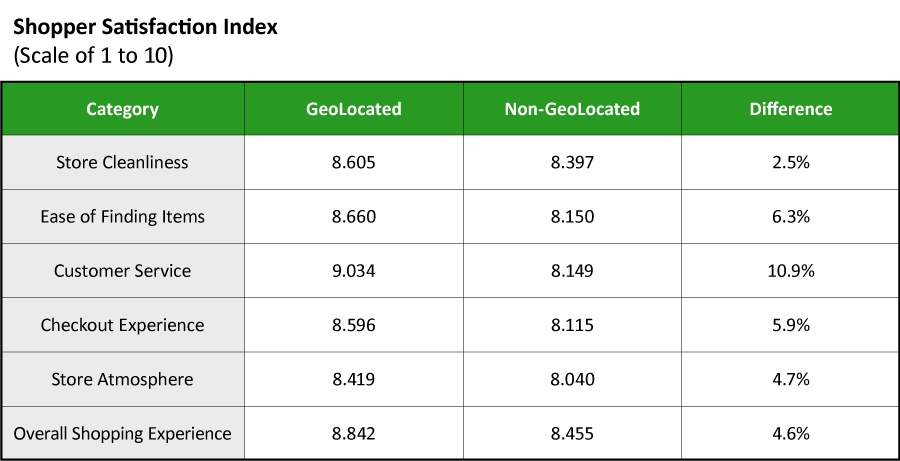
Asked to rate their satisfaction with their most recent shopping experience on a scale from one to ten, the GeoLocated group had an average score of 8.842 – 4.6% higher than the non-GeoLocated group’s score of 8.455.


The pattern held as the questioning grew more specific. Respondents were asked to rate their most recent shopping experiences by five additional measures, and the GeoLocated group that answered with the experiences fresh-in-mind reported greater satisfaction in every category. Here are the results:

Shopper Satisfaction Index


Our comparative study suggests new insights into how consumers’ perceived satisfaction erodes over time. Was it a case of not enjoying their purchases as much as they’d expected when they were in the checkout lane? Or does this indicate something broader about consumer perceptions changing over time? In any case, for accurate insights it’s important to probe for the truth as swiftly as possible after consumers have had the experience you’re studying.


In our blog posts earlier this week, we reported marked differences in recall between the two groups in the comparative mobile GeoLocation study. When it came to remembering the product categories in which they’d made purchases, recall was 100% for the GeoLocated group. In the non-GeoLocated control group, only 72% were able to recall product categories from their most recent shopping trip. The same pattern held for brand recall, with non-GeoLocated respondents consistently less able to name the brands they’d bought.


To sum up, timing is of the essence when it comes to getting an accurate picture of how consumers think, act and feel. If you don’t GeoLocate, you’ll get a sketch from memory. But if you use top mobile technology to find respondents in the places most relevant to your research, then follow up with an immediate survey, you’ll get a near-photographic record of shoppers’ reality. Sketches give you an impression; photo-realism tells you what is. Which do you think lays a better basis for making good business decisions?


So try in-location or after-visit mobile GeoLocation surveys to get to know your customers better. No other methodology can bring you this close to the Point of Emotion® – the moment when shoppers make their buying decisions. For full details – and an unforgettable research experience – contact us at sales@mfour.com.


Topics: MFour Blog

Flawed Recall Means Fractured Data. Use GeoLocation to Solve Memory Decay.

Posted by admin on Mar 8, 2017 10:41:07 AM


170419-stressed-woman-work-computer-ew-1233p_91e3fb27b3cc827e94d1b6fe3987ea5f.fit-2000w


Memories fade with time.

That decay may be impacting the way you do surveys. Why?

If you wait until long after they’ve left the cash register to field a survey, chances are you’ll be getting a vague likeness sketched from memory, when you should be capturing data that tells the photographic truth.

That’s why it’s important to take a deeper look at MFour’s comparative study of 200 GeoLocated mobile shoppers’ buying decisions, measured against a control group of non-GeoLocated respondents.

In an eye-opening study, panelists in the GeoLocated group were identified with the help of proprietary mobile GeoIntensity® technology, while actually shopping at a store in one of five designated retailer categories (convenience, grocery, drug store, club membership, mass market).

These panelists then received a survey alert, again abetted by a proprietary technology, GeoNotification®, just as they left the store, and were asked to complete it within three hours. Members of a demographically similar control group were asked to recall their most recent visit to stores in the same five retail categories, in a survey that captured their stated memories.

As is the case in most non-GeoLocated surveys, this meant that the control group had to fall back purely on memories of experiences that for most had happened days or weeks earlier.

Only 72% of non-GeoLocated respondents were able to recall whether they had bought products in 8 broadly-defined categories (beverages, cookies, chips, personal care products, prepared foods, deli, produce, and pet food).

In contrast, recall for these categories was 100% among the GeoLocated group that took the survey within three hours of the shopping experience.

Also revealing was a significant recall gap when it came to remembering which brands respondents had purchased.

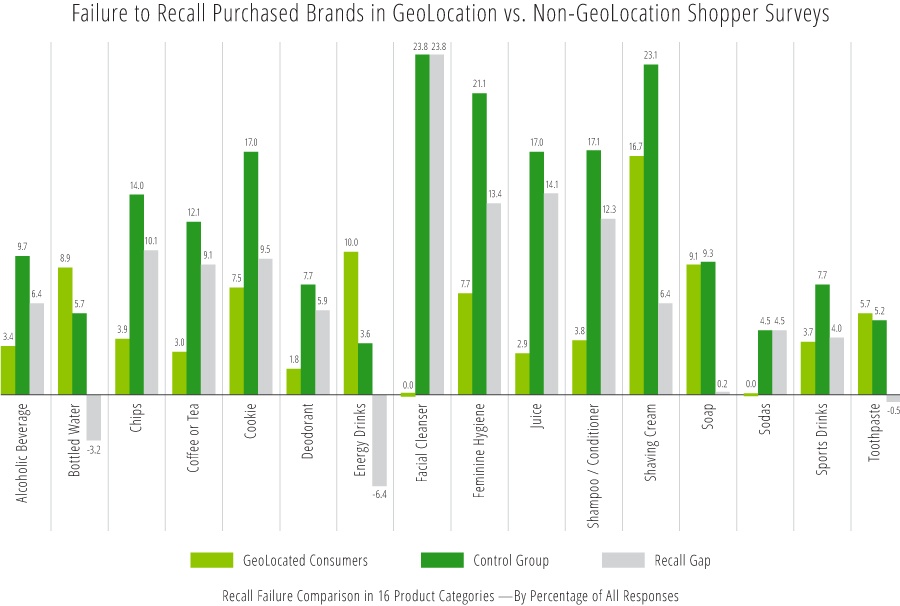
Both groups were asked to name brands they had bought in 16 more narrowly-defined categories. For example, instead of the broad product category of beverages, we asked more specifically for purchased-brand recall. This included carbonated drinks, alcoholic beverages, juices, bottled water, sports drinks, energy drinks, and tea/coffee.

The chart below contrasts the two groups’ ability to recall the brands they had bought. Figures state the percentage of respondents unable to recall brands.


Recall Gap Grid2

Time, it turns out, really is of the essence.

Particularly when it comes to survey-based consumer research. And that goes for your next research project. There’s no need to settle for flawed responses. Take the first step with GeoLocation technology that gets you the in-the-moment insights.

To learn more, contact sales@mfour.com.


Topics: MFour Blog

Study Compares Recall Versus In-the-Moment Surveys

Posted by admin on Mar 7, 2017 9:29:28 AM


geolocator_900x300


If you want to know what consumers buy, you’d better not hesitate to ask. Because if you don’t ask fast enough, your data will fall into a recall gap – the chasm that opens when you rely on days-old (or weeks-old) memories instead of capturing consumer sentiment when the experience is fresh in mind.


That’s the takeaway from a comparative study MFour conducted to explore how memory decay impacts data reliability. The results underscore how using GPS-enabled technology lets you reach the right consumers in the right place at the right time for insights that can truly drive the right business decisions.


The study involved fielding essentially the same mobile survey to two demographically similar groups of 200 consumers. GeoLocation told us that our first group had been shopping that very day in at least one of the five retailer categories in the study – grocery stores, convenience stores, drug stores, membership club stores, and mass merchants.


These panelists were identified inside specific stores and received in-app push notifications just as they walked out the door to learn about their shopping experiences. The non-GeoLocated control group was asked about most recent shopping experiences in the same store types – which may have occurred days, weeks, or even months earlier.


Key Findings

  • When asked to state whether they had purchased products in any of eight general categories (beverages, personal care, etc.) during their most recent store visit, all 200 GeoLocated respondents named one or more categories. Not one of them selected the “Don’t know/Can’t remember” option.
  • That contrasts with 28% of the non-GeoLocated control group who said they could not remember which product categories they’d purchased during their most recent store visit.
  • There were also significant gaps when it came to recalling the brands our respondents had bought. The GeoLocated group had a brand recall advantage for 13 of 16 specific product types.
  • Notable brand recall gaps include differences of 23.8% for facial cleansers, 14.1% for juices, 13.4% for feminine hygiene products, 12.3% for shampoos/conditioners, and 10.1% for snack chips.

Conclusion


Talking to consumers when an experience is fresh in mind is crucial for obtaining accurate data about any kind of experience. Exploiting GeoLocation and other key smartphone features takes you as close to the moment of purchasing truth as you can get without tagging along in person. This is why a Point of Emotion® response, capturing data the moment when information is at its most memorable, is the most reliable way to understand what consumers really think.


To learn more about how to keep your research from falling into the recall gap, just reach out by clicking sales@mfour.com. And be sure to check the MFour blog throughout the week for more insights from this study.

Topics: MFour Blog

Alcohol Can Cause Memory Loss. So Can Waiting Too Long to Find Respondents.

Posted by admin on Mar 6, 2017 10:42:33 AM

alcoholrecall_900x300


We’ve all heard the saying, “it’s all in the timing” – and we all know it’s true. Whether it’s a golf swing, grilling a steak, or issuing a multi-billion dollar IPO, the key to a good outcome is taking the right action at the right time. It’s no less true for survey-based market research. What happens if you ask consumers the right question at the wrong time? What if you ask at absolutely the worst time – that is, after your respondents already have forgotten the experience you’re asking about? MFour decided to gather some data to quantify the cost of getting the timing wrong.


We’ll be sharing the results Tuesday on this blog and in our weekly Tuesday newsletter. For now, here’s one insight: a survey method that emphasized getting the timing right by using GeoLocation to find panelists while they were still shopping, followed by a survey notification just as they left the store, suffered 3.4% non-recall about what brand the respondent had bought. In a survey that skipped GeoLocation and relied solely on memory, 9.7% of respondents said they couldn’t remember the alcoholic beverage brand they’d bought.


To find out more about how survey timing affects consumer recall,  just come back tomorrow. Don’t forget!


Topics: MFour Blog

Subscribe to Email Updates

Recent Posts