

admin

Recent Posts

Trump vs. Clinton Polling Is Giving Online Research a Black Eye

Posted by admin on Oct 5, 2016 9:42:04 AM

trumpclinton-by-gage-skidmore


Photo credit: Michael Vadon (Donald Trump); Gage Skidmore (Hillary Clinton)


Here’s more bad news for online surveys: they’ve now been roped into the mudslinging of the presidential campaign, which can only mean more mud is being splattered indiscriminately on their reputation.


A recent headline in the New York Times reads “Why You Shouldn’t Trust `Polls’ Conducted Online.” The article details how data from respondents who answer invitations to take polls posted on news organizations’ websites is more or less worthless. These survey-takers simply aren’t representative of the voting public.


Granted, online market research has a much firmer basis in reality than the stunt-like ad-hoc online political polls the Times wrote about. But that basis is crumbling fast, and it’s dawning on many market researchers and clients that the data online research surveys produce has tumbled into a sinkhole of unreliability.


It’s a rare online research supplier that will publish its panel’s characteristics in detail. But researchers deserve to know who’s going to answer their questions, and anything less than open disclosure can breed doubt and distrust that's unhealthy for any industry.


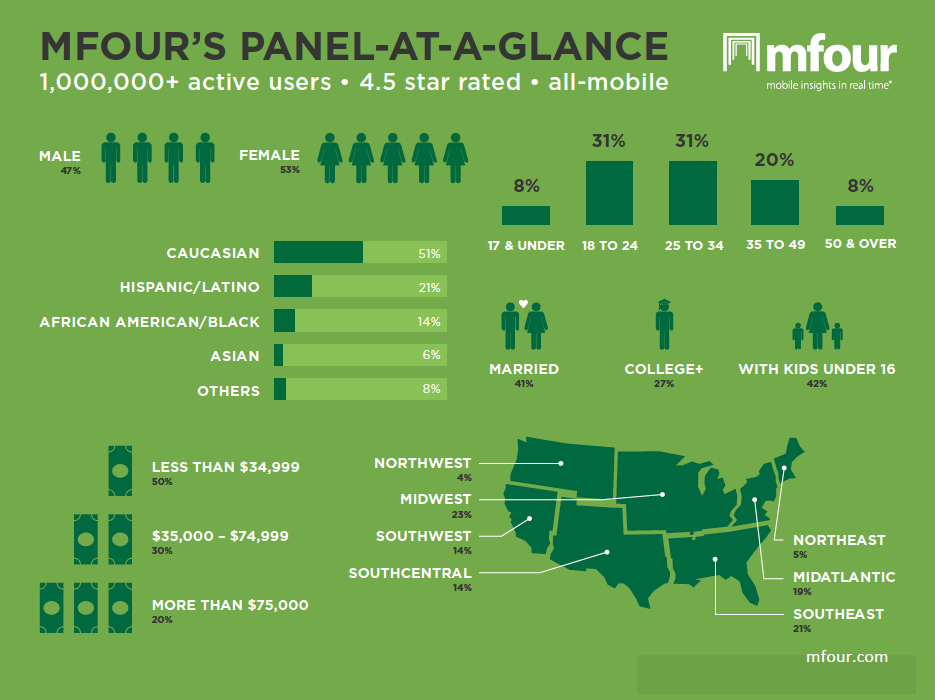
For full disclosure of the demographic characteristics of the million-plus active members who make up MFour's Surveys on the Go® panel, just scroll to the bottom of this post. Please let us know if you can find comparable transparency elsewhere.


We did find one example in which a supplier of online sample published  a detailed statistical profile of its panel composition in the U.S. Kudos to that  company for doing the right thing.


But the facts it's sharing only add hard evidence that explains the rising note of discontent among end-users of market research, as the realization sinks in that the online surveys they're buying no longer are delivering the reliability and efficiency they need.


The supplier in question states that it has well over one million panelists in the U.S., of whom 71% are women. That's way out of sync with the reality of human biology, let alone the reality of the marketplace. It also lists the ethnicities represented on its panel – but glaringly omits Hispanics/Latinos. If research can’t connect with a representative cohort of U.S. Hispanics, how can it be in touch with the reality of the American marketplace?


Lastly, it acknowledges that only about 20% of its respondents complete surveys on a mobile device. 


As many studies have made clear – not least MFour’s ongoing Millennial Insights Project -- mobile devices are contemporary society’s crucial, dominant, definitively pervasive (supply your own adjective) means of communication and information exchange. How can any industry, especially MR, whose raison d’etre is keeping a finger on the public pulse, credibly claim to be engaging a representative cross-section of the public if it’s communicating in ways most of the public regards as all but archaic?


We grant that, unlike the instant online presidential polls that will continue to proliferate from now to Election Day, online market research has integrity and does all it can to serve clients honorably and effectively. Its methods were verifiably effective for many years. But mobile technology has changed the world, and online’s day has passed. Soon it will be like the phone booth or the electric typewriter – a one-time necessity that fell into near-total disuse because technology transformed how the public communicates and transmits information.


“Follow the money” was the signature line from “All the President’s Men,” a classic film about the earthshaking political fallout from the 1972 presidential election. In market research, the new imperative is “follow the consumers.” The consumers are not online. They are to be found on mobile – in all their glorious, fully-representative diversity.


Research needs to be there, too.


As promised, here's the panel you'll get when you go with MFour. Please feel free to pass our chart around.

 

mfour-panel-at-a-glance


Topics: News, MFour Blog, political, trump, hillary

Want to Learn More About MFourDIY™?

Posted by admin on Oct 3, 2016 12:01:35 PM

To learn how you can harness MFourDIY™ and its sophisticated yet easy-to-use capabilities, tune in to one of our webinars. The next one, Wednesday, Oct. 19 at 12 p.m. PST, will  give you a good introduction. The title is “MFourDIY: Getting Started." To sign up, click here.

Topics: MFour Mobile Research, MFour Blog, mfourdiy, mobile, mrx

1,000-Millennial Study: Views on Technology

Posted by admin on Oct 3, 2016 9:48:46 AM

audience-945449_1920

To wind up the first phase of MFour’s Millennial Insights Project, here's Part 3, on Millennials' views on Technology & Lifestyle -- with a focus on the smartphones and other computing devices that are the dominant technology in their lives.

Our study aims to generate insights into this crucial, much-analyzed consumer cohort of more than 75 million Americans, while demonstrating to the market research industry that the fastest, most reliable and effective way to reach Millennials is on the devices that define them -- the smartphones from which, as the results below show, they are in many cases literally inseparable. 

The data for this report -- and for the  previous segments on Millennials & Entertainment and Millennials & Money and Finance -- was obtained through the first wide-ranging, demographically representative study of Millennials undertaken solely by smartphone app. The fundamental premise is that Millennials are best engaged -- and will have the most comfortable and productive survey-taking experience -- on the mobile devices  that fully engage them in all phases of their lives.

Using MFourDIY™,  the first all-mobile, do-it-yourself survey platform, we obtained 1,000 validated responses within two hours from Millennials on the million-member active panel that uses the Surveys on the Go® smartphone app. The 30-question survey covered Entertainment, Money & Finance and Technology & Lifestyles, giving a representative picture of the U.S. Millennial population by sex, age, race/ethnicity, income and employment status.

These are key insights on how Millennials use smartphones and other computing devices.

Mobile is Multiple: Smartphone owners haven’t abandoned other computing devices – as long as those other devices meet the portability test. 87.1% also own a laptop, and 71.4% have a tablet.

But Smartphones are Essential: 92.3% of Millennials said they use their phones at least several times a day, compared to 32.1% for laptops. 44.9% said they spend at least five hours a day on their smartphones – compared to 23.3% who spend five or more hours on a personal computer (desktop or laptop). 79.3% of Millennials use their phones at least two hours a day, compared to 45.7% for personal computers.

Only 3.8% of respondents said they use their smartphones less than an hour a day. Millennials are far more likely to make sparing use of laptops and/or desktops - 26.3% report using them less than an hour a day.

A Constant Companion: 45.3% of Millennials say they keep their smartphones with them 24-7. 93.2% say they keep their phones on their persons or nearby at least 10 hours a day.

Minorities are Really Into Their Phones: Majorities of African Americans (57.1%) and Hispanics (51.6%) reported spending five hours or more per day on their phones; Asians (42%) also exceeded Caucasians (38.9%) when it came to epic phone usage.

Desktops are Bottoming Out: Millennials are pushing the granddaddy of personal computers into retirement. Only 45.2% of them own a desktop; men are the diehards, with 50.6% still holding on to desktops, compared to just 39.8% of women. Affluence is another predictor for ownership of what most Millennials apparently perceive as a luxury they can live without. 54.2% of respondents living in households with annual incomes of at least $75,000 said they had a desktop as well as a smartphone. Desktop ownership in Millennial households with earnings under $50,000 was 42%.

Only one-third of Millennials (33.1%) say they use a desktop computer at least once a day. Almost as many (30%) are now using wearable devices such as smart watches at least once a day.

Whole Lotta Checkin’ Goin’ On: 88.7% of Millennials check text messages the moment they get them. They’re considerably less compulsive about social media and app notifications (41.2% and 40.5%, respectively, get checked immediately). Email continues to trend downward -- just 35.3% get opened right away. 51% check their apps' push notifications at least once an hour, compared to 48.6% for email. 

OK With Their OS: Overall, Millennials seem satisfied with whatever smartphone operating system they’re using now. Those saying they were likely or very likely to switch (25.6%) were outnumbered two-to-one by those who said they were unlikely or very unlikely to make a change (51.9%). That left 22.5% who could go either way.

However, there were  differences  in the degree of loyalty commanded by Apple's iOS system and Google's Android. They were comparable when it came to their shares of loyal users -- -- 53.8% of iOS users and 50.4% of Android users said they were likely or very likely not to switch devices. But on the other end, Android users were twice as likely to express  discontent: 32.9% said they were likely or very likely to switch to a different OS, compared to 16.7% for iOS.

Can Google poach some of the 29.5% of iOS users who said they were neutral about keeping their current system, while persuading the 16.7% of neutral Android users to stay? Can Apple succeed in prying loose the one-third of Android-using Millennials who apparently are unimpressed with Google's system? Or, with nearly half of Millennials either poised to change operating systems or sitting on the fence, is there an opening for other system designers to compete?

Meet Your Next App: When it comes to discovering new apps to download, Millennials rank advice from family and friends (61%), social media (60.4%) and Apple and Google’s app stores (56.7%) as by far the biggest influences. The advertising about apps that's most likely to influence them is the kind they they receive through an app -- 33..6% of Millennials cited in-app advertising as a factor, compared to 23.4% who said ads on television, radio or in print media helped them discover new apps. News coverage ranked last as a portal to discovering, cited as an influence by 15.1%.

When it came to using  social media to discover apps to download, women were notably more active than men -- 67.6% to 53.2%. The same goes for legacy advertising (television, radio and print), cited by 27.4% of women and 19.4% of men. African Americans also stood out in citing legacy advertising channels as a source of information about apps – 37.1% compared to 22.6% of Hispanics and 20.5% of Caucasians. 

Just A Few Go A Long Way: About half of Millennials (50.7%) use 4 to 6 different mobile apps per day. At the extremes, just 15.4% use no more than 3 apps daily, and 13.5% use 10 or more. App usage varies little across ethnicities, age segments and gender.

Methodology


Using MFourDIY, the market research industry’s first all-mobile, do-it-yourself platform for designing and carrying out studies, MFour fielded a 30-question survey on Sept. 10 to Millennials who make up about 60% of its million-member active panel, all of whom participate in research via the Surveys on the Go® app for smartphones and tablets. Fielding time was less than two hours for 1,000 validated responses.

Responses reflected U.S. Millennials’ demographic profile: 50% male, 50% female; 56% Caucasian, 19% Hispanic/Latino, 14% African American/Black, 5% Asian, 1% each for Middle Eastern, Pacific Islanders and Native Americans/Alaskans; 3% Other. Age brackets were 18-24 (36%), 25-29 (31%) and 30-36 (33%). The study also segmented respondents by whether they were parents of children under 18, their type of work (full-time blue collar and white collar, part-time, unemployed), and their income (six brackets from $25,000 or less to $100,000 or more).

To read our previous reports, for Part 1, Entertainment, click here.

For Part 2, Money & Finance, click here

To view  all survey data, visit  surveysonthego.net/tracker and use these login credentials:

Username: MillennialCaseStudy

Password: MFourMillennials

Topics: MFour Mobile Research, News, technology, MFour Blog, millennials, smartphones

3 Weekly Insights on Mobile

Posted by admin on Sep 30, 2016 12:59:37 PM
Here's your Friday roundup of 3 items from the MFour blog to keep you up to speed on mobile research as you head into the weekend.
Whatever else you do, don't forget to check at the bottom for something to mobilize your spirits and get you humming.
And here's a  Friday tune to send you bopping and smiling into your weekend.

Topics: MFour Mobile Research, MFour Blog, millennials, blackberry, international business times

What BlackBerry Losing its Juice Means to MR

Posted by admin on Sep 29, 2016 5:17:58 PM


blackberries-1612883_1920


A blackberry is once again just a pricey item in the produce aisle, now that its once-dominant technological namesake, BlackBerry, will no longer be manufacturing BlackBerrys. 


This exit from the mobile hardware marketplace was far from unexpected. Although BlackBerry was an innovator and muscular market force when it introduced the earliest devices to combine email, web access and telephonic communications in a single hand-held unit, that was in the early 2000s. Starting in 2007, Apple’s iPhones and Google’s Android system quickly captured the public’s attention, affection, and purchasing power, and BlackBerry’s sales rapidly declined.


The BlackBerry’s saga resonates with MFour, because we’ve also been a pioneer in mobile technology – in our case, the development and advancement of Surveys on the Go®, the first and still only all-mobile market research app. We rolled it out in 2011 and have been advancing its functionality and utility ever since.


We work both sides of the technological street: improving the experience for the survey-takers who use the app, and for the clients who field surveys to panelists. Surveys on the Go® now has more than one million active panelists; with no recruiting on our part, membership keeps growing by more than 2,000 a day -- a word-of-mouth testament to the user experience SOTG members enjoy. 


The core premise is that the better the panelist’s experience, the better the data quality will be. People love carrying out tasks on their smartphones – as long as all goes smoothly. We make the match between researchers’ needs and the public’s enthusiasm for technologically-driven pleasures. Call it serious fun – fun for respondents, leading to serious consumer insights for researchers.


The takeaway from the story of BlackBerry is that innovators can’t relax. Sure, it’s OK to take a deserved bow for having conceived and birthed a new product, service or delivery system. But then you have to keep on innovating. There’s no basking in the afterglow of conception when you’re confronted with the never-ending challenge of optimizing the function and utility of whatever it is you’ve conceived. A BlackBerry was the coolest device you could pull out of a pocket or a handbag -- until it wasn't.


The driveshaft of MFour and Surveys on the Go® is our Labs & Engineering division. Its staff constantly devises upgrades both subtle and sweeping to ensure that our panelists will enjoy the easiest, most engaging survey-taking experience on their mobile devices. L&E also is obsessed with anticipating the MR industry’s needs – which means expanding researchers’ options for obtaining ever-richer data and insights, while minimizing the time and effort it takes to obtain them.


A leading example of our stamina as innovators is MFourDIY™, the first all-mobile, do-it-yourself research tool. We debuted it in April, and have been adding further new research capabilities since then, both on the do-it-yourself platform and in our core, custom-designed surveys. Also new this year is our app-tracking feature, which allows clients to sort and query panelists according to which apps they use. It’s one more option for identifying and interviewing the consumers most relevant to the research task at hand.


"In the mobile space you've got to always start new," says Chris Monahan, MFour's Chief Technology Officer. "BlackBerry just got too comfortable. It's about always staying on the cutting edge, and riding the wave."


This, Chris adds, is a pleasure, not a chore.


"At our core, we love technology. Like kids at Christmas time, we love the latest cell phones and new server technologies. We are geeks who love to learn and share this excitement with each other. This culture is what drives the SOTG platform. If we aren't using the latest and greatest in technology, we become stagnant."


The consequences of stagnation are very real in any business: keep moving, or you might get squished. If you need a reminder, look to the produce aisle.


Topics: News, MFour Blog

MRA SoCal Panel Event Looks at Multicultural Identity & Marketing

Posted by admin on Sep 29, 2016 1:28:44 PM


mra-socal-logo


What are the special questions of identity that U.S. minorities grapple with – shaping their lives, including their lives as consumers?


The MRA’s SoCal Chapter will delve into this hugely important question in its 6th annual Multicultural Event, Thursday, Oct. 13, at 6 p.m. at the 1919 restaurant in San Diego’s Gaslamp District.


Todd Costello, MFour Senior Solutions Executive and chapter President, invites anyone who’s interested to register for the panel discussion, which is open to members and non-members alike (see details below).


“We have an experienced panel of multicultural market research practitioners speaking on the dilemma every minority person faces as it relates to acculturation vs. assimilation among U.S. Hispanic, Asian and African Americans,” Costello said.


Carlos Garcia of Garcia Research will be the moderator; other panelists are Lawrence Yeung (361 Degrees Consulting, Inc.), Gwen Young (Young Communications Group, Inc.), David Morse (New American Dimensions) and Marissa Romero-Martin (Culturati).


Admission is $45, $25 for students, and includes an open bar, appetizers and desserts.

Seating is limited and fills up fast.


Networking and refreshments are from 6 to 7 p.m.

The program runs from 7 p.m. to 9 p.m.


Register at:

http://www.cvent.com/d/1vqzts


Topics: News, MFour Blog

International Business Times Runs Our Millennial Survey Findings

Posted by admin on Sep 28, 2016 9:52:50 AM

International Business Times, leading provider of business news and current headlines from the US and around the world, ran our report on Millennials on Money & Investing.

Click here to read the full article.

Topics: MFour Mobile Research, MFour Blog, international business times

Are you at CRC This Week?

Posted by admin on Sep 27, 2016 11:26:30 AM

If you're at CRC Corporate Researchers conference this week in San Francisco, check out our booth #401 and let's talk mobile!

Topics: Uncategorized

1,000-Millennial Study: Views on Money & Finance

Posted by admin on Sep 26, 2016 12:48:07 PM


creditcard


Welcome to the second of three weekly reports from MFour’s Millennial Insights Project.


This study is driven by a different idea in market research: if you want to reach Millennials, a generation that remains elusive  to researchers even though it continues to be studied to the hilt, you have to talk to them where they live – on their smartphones. This  project is the first wide-ranging, demographically representative study of Millennials undertaken solely by smartphone app, the communications/information interface with which they are most comfortable and fully engaged.


Using MFourDIY™ -- the first all-mobile, do-it-yourself survey platform --we obtained 1,000 validated responses within two hours from Millennials on the million-member active panel that uses the Surveys on the Go® smartphone app. The 30-question survey covered Entertainment, Money & Finance and Technology & Lifestyles, giving a representative picture of the U.S. Millennial population by sex, age, race/ethnicity, income and employment status.

This is Part 2, Money & Finance. You can read Part 1, Entertainment, by clicking the link at the end of this post. Part 3 on Technology & Lifestyles is coming Tuesday, Oct. 4. 

Here are some of the insights the survey delivered on how Millennials manage their money.

  • Banking on the Go: 61.2% of Millennials say they most prefer to do their banking with mobile apps, and 69.1% said they’d done just that during the previous week. 82.7% had used a mobile banking app during the past month. Mobile was the most preferred banking method across all racial and ethnic demarcations, age groupings and income brackets. The groups most likely to make mobile banking their first choice were Hispanics (71.1%) and Millennials with incomes of $75,000 or more (65.5%).
  • Still going to the bank, but not gladly: Only 18.1% of Millennials said they prefer to do their banking in person. But nearly two-thirds (63.9%) said they’d been to the bank during the past month. Will this generation continue to patronize institutions that don’t satisfy a strong consumer preference?
  • Not  keen on personal computers: Only 12.5% of respondents cited desktop or laptop computers as their preferred interface for banking.
  • But they still use them: 71.6% of Millennials said they had used a personal computer for banking during the past month – although the number fell to 66.7% for the youngest age bracket, 18-24. The younger Millennials also were less likely to use a PC to make a payment – 51.1% in the past month, compared to 61.2% of all Millennials.
  • Checks face checkmate:  Only 17% of respondents had written a check during the previous week. 26.6% said it had been six months or more since they’d written a check, and 24% said they never had used a check. 87% of Millennials have a checking account -- more than any other banking product -- so maybe it’s time for marketers to find a new name to reflect an increasingly check-free landscape.
  • Apps top cash: Mobile apps such as PayPal and Venmo edged cash (34.5% to 32%) as the way Millennials most prefer for transferring money to family and friends. Do not write a gift check to a Millennial if you can help it: only 10% said they prefer checks for transactions with family and friends.
  • Hackers? No worries: Asked how confident they are in the security of banking/finance apps, only 9.7% of Millennials stated any concern. 62.9% were confident or very confident, and 27.4% neutral. Those who said they were very confident outnumbered those who had no confidence in app security by almost 8 to 1 (26.9% to 3.6%).

Interestingly, a recent Harvard University survey of Millennials ages 18 to 29 found that only 11% expressed trust in “Wall Street” – that is, banking and finance as a whole. In our survey, 28% of Millennials ages 18-29 said they were “very confident” in banking/finance apps. Is this an indicator that Millennials’ attitudes can change when they interface with institutions on their generation’s own, technology-loving terms?

  • Asian Americans well positioned: Asian American Millennials report that they've adopted many of the behaviors  financial advisors strongly advocate. For example, 60% pay off their entire credit balance each month – nearly double the average of 31.1% for all Millennials. 

Methodology


Using MFourDIY, the market research industry’s first all-mobile, do-it-yourself platform for designing and carrying out studies, MFour fielded a 30-question survey on Sept. 10 to Millennials who make up about 60% of its million-member active panel, all of whom participate in research via the Surveys on the Go® app for smartphones and tablets. Fielding time was less than two hours for 1,000 validated responses.


Responses reflected U.S. Millennials’ demographic profile: 50% male, 50% female; 56% Caucasian, 19% Hispanic/Latino, 14% African American/Black, 5% Asian, 1% each for Middle Eastern, Pacific Islanders and Native Americans/Alaskans; 3% Other. Age brackets were 18-24 (36%), 25-29 (31%) and 30-36 (33%). The study also segmented respondents by whether they were parents of children under 18, their type of work (full-time blue collar and white collar, part-time, unemployed), and their income (six brackets from $25,000 or less to $100,000 or more).


To read our previous report, Part 1, Entertainment, click hereTo view  all survey data, visit  surveysonthego.net/tracker and use these login credentials:


Username: MillennialCaseStudy

Password: MFourMillennials

Topics: MFour Blog

Want to Learn More About MFourDIY™?

Posted by admin on Sep 26, 2016 10:05:54 AM

To learn how you can harness MFourDIY™ and its sophisticated yet easy-to-use capabilities, tune in to one of our webinars. The next one, Wednesday, Oct. 19 at 12 p.m. PST, will give you a good introduction. The title is “MFourDIY: Getting Started." To sign up, click here.

Topics: MFour Mobile Research, webinar, MFour Blog, mfourdiy, how to

Subscribe to Email Updates

Recent Posts