
admin

Recent Posts

Memory is Fleeting. So GeoLocate Shoppers in the Nick of Time.

Posted by admin on Mar 9, 2017 10:21:31 AM


point of emotion 900x300


When you’re looking for insights into shopper satisfaction, you’re asking for trouble if you rely on panelists to fall back on recall when they tell you about their in-store experiences. Timing truly matters – and a new comparative study suggests that there’s a consistent difference between the truth shoppers tell about their experiences in-the-moment, and what they say after the experience has slipped into the recent past. The good news is that in-the-moment insights are yours for the asking – if you remember to GeoLocate shoppers when their experiences are fresh in mind.


It turns out that waiting to ask about shopper satisfaction will skew your data. That’s one of the takeaways from a comparative study in which 200 GeoLocated consumers took mobile surveys within three hours of a shopping experience. They consistently reported greater satisfaction than those in a similarly-composed control group that was not GeoLocated, and therefore fell back on memories that appeared to tarnish over time.


Asked to rate their satisfaction with their most recent shopping experience on a scale from one to ten, the GeoLocated group had an average score of 8.842 – 4.6% higher than the non-GeoLocated group’s score of 8.455.


The pattern held as the questioning grew more specific. Respondents were asked to rate their most recent shopping experiences by five additional measures, and the GeoLocated group that answered with the experiences fresh-in-mind reported greater satisfaction in every category. Here are the results:
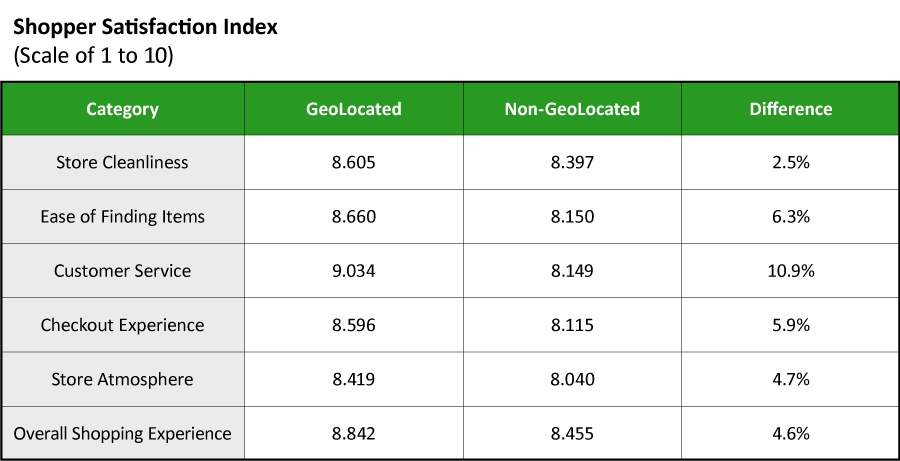
Shopper Satisfaction Index


Our comparative study suggests new insights into how consumers’ perceived satisfaction erodes over time. Was it a case of not enjoying their purchases as much as they’d expected when they were in the checkout lane? Or does this indicate something broader about consumer perceptions changing over time? In any case, for accurate insights it’s important to probe for the truth as swiftly as possible after consumers have had the experience you’re studying.


In our blog posts earlier this week, we reported marked differences in recall between the two groups in the comparative mobile GeoLocation study. When it came to remembering the product categories in which they’d made purchases, recall was 100% for the GeoLocated group. In the non-GeoLocated control group, only 72% were able to recall product categories from their most recent shopping trip. The same pattern held for brand recall, with non-GeoLocated respondents consistently less able to name the brands they’d bought.


To sum up, timing is of the essence when it comes to getting an accurate picture of how consumers think, act and feel. If you don’t GeoLocate, you’ll get a sketch from memory. But if you use top mobile technology to find respondents in the places most relevant to your research, then follow up with an immediate survey, you’ll get a near-photographic record of shoppers’ reality. Sketches give you an impression; photo-realism tells you what is. Which do you think lays a better basis for making good business decisions?


So try in-location or after-visit mobile GeoLocation surveys to get to know your customers better. No other methodology can bring you this close to the Point of Emotion® – the moment when shoppers make their buying decisions. For full details – and an unforgettable research experience – contact us at sales@mfour.com.



Topics: MFour Blog

Flawed Recall Means Fractured Data. Use GeoLocation to Solve Memory Decay.

Posted by admin on Mar 8, 2017 10:41:07 AM


170419-stressed-woman-work-computer-ew-1233p_91e3fb27b3cc827e94d1b6fe3987ea5f.fit-2000w


Memories fade with time.

That decay may be impacting the way you do surveys. Why?

If you wait until long after they’ve left the cash register to field a survey, chances are you’ll be getting a vague likeness sketched from memory, when you should be capturing data that tells the photographic truth.

That’s why it’s important to take a deeper look at MFour’s comparative study of 200 GeoLocated mobile shoppers’ buying decisions, measured against a control group of non-GeoLocated respondents.

In an eye-opening study, panelists in the GeoLocated group were identified with the help of proprietary mobile GeoIntensity® technology, while actually shopping at a store in one of five designated retailer categories (convenience, grocery, drug store, club membership, mass market).

These panelists then received a survey alert, again abetted by a proprietary technology, GeoNotification®, just as they left the store, and were asked to complete it within three hours. Members of a demographically similar control group were asked to recall their most recent visit to stores in the same five retail categories, in a survey that captured their stated memories.

As is the case in most non-GeoLocated surveys, this meant that the control group had to fall back purely on memories of experiences that for most had happened days or weeks earlier.

Only 72% of non-GeoLocated respondents were able to recall whether they had bought products in 8 broadly-defined categories (beverages, cookies, chips, personal care products, prepared foods, deli, produce, and pet food).

In contrast, recall for these categories was 100% among the GeoLocated group that took the survey within three hours of the shopping experience.

Also revealing was a significant recall gap when it came to remembering which brands respondents had purchased.

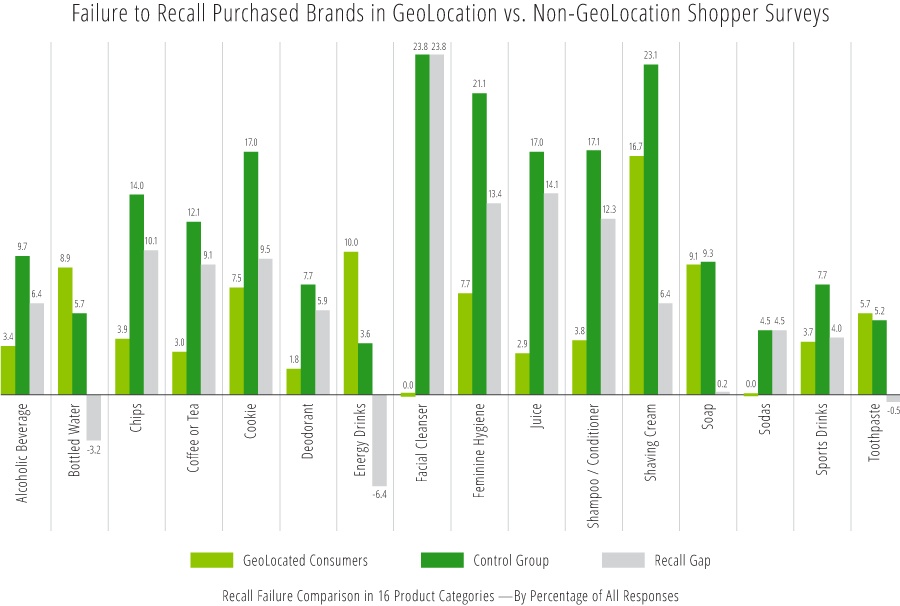
Both groups were asked to name brands they had bought in 16 more narrowly-defined categories. For example, instead of the broad product category of beverages, we asked more specifically for purchased-brand recall. This included carbonated drinks, alcoholic beverages, juices, bottled water, sports drinks, energy drinks, and tea/coffee.

The chart below contrasts the two groups’ ability to recall the brands they had bought. Figures state the percentage of respondents unable to recall brands.


Recall Gap Grid2

Time, it turns out, really is of the essence.

Particularly when it comes to survey-based consumer research. And that goes for your next research project. There’s no need to settle for flawed responses. Take the first step with GeoLocation technology that gets you the in-the-moment insights.

To learn more, contact sales@mfour.com.


Topics: MFour Blog

Study Compares Recall Versus In-the-Moment Surveys

Posted by admin on Mar 7, 2017 9:29:28 AM


geolocator_900x300


If you want to know what consumers buy, you’d better not hesitate to ask. Because if you don’t ask fast enough, your data will fall into a recall gap – the chasm that opens when you rely on days-old (or weeks-old) memories instead of capturing consumer sentiment when the experience is fresh in mind.


That’s the takeaway from a comparative study MFour conducted to explore how memory decay impacts data reliability. The results underscore how using GPS-enabled technology lets you reach the right consumers in the right place at the right time for insights that can truly drive the right business decisions.


The study involved fielding essentially the same mobile survey to two demographically similar groups of 200 consumers. GeoLocation told us that our first group had been shopping that very day in at least one of the five retailer categories in the study – grocery stores, convenience stores, drug stores, membership club stores, and mass merchants.


These panelists were identified inside specific stores and received in-app push notifications just as they walked out the door to learn about their shopping experiences. The non-GeoLocated control group was asked about most recent shopping experiences in the same store types – which may have occurred days, weeks, or even months earlier.


Key Findings

  • When asked to state whether they had purchased products in any of eight general categories (beverages, personal care, etc.) during their most recent store visit, all 200 GeoLocated respondents named one or more categories. Not one of them selected the “Don’t know/Can’t remember” option.
  • That contrasts with 28% of the non-GeoLocated control group who said they could not remember which product categories they’d purchased during their most recent store visit.
  • There were also significant gaps when it came to recalling the brands our respondents had bought. The GeoLocated group had a brand recall advantage for 13 of 16 specific product types.
  • Notable brand recall gaps include differences of 23.8% for facial cleansers, 14.1% for juices, 13.4% for feminine hygiene products, 12.3% for shampoos/conditioners, and 10.1% for snack chips.

Conclusion


Talking to consumers when an experience is fresh in mind is crucial for obtaining accurate data about any kind of experience. Exploiting GeoLocation and other key smartphone features takes you as close to the moment of purchasing truth as you can get without tagging along in person. This is why a Point of Emotion® response, capturing data the moment when information is at its most memorable, is the most reliable way to understand what consumers really think.


To learn more about how to keep your research from falling into the recall gap, just reach out by clicking sales@mfour.com. And be sure to check the MFour blog throughout the week for more insights from this study.

Topics: MFour Blog

Alcohol Can Cause Memory Loss. So Can Waiting Too Long to Find Respondents.

Posted by admin on Mar 6, 2017 10:42:33 AM

alcoholrecall_900x300


We’ve all heard the saying, “it’s all in the timing” – and we all know it’s true. Whether it’s a golf swing, grilling a steak, or issuing a multi-billion dollar IPO, the key to a good outcome is taking the right action at the right time. It’s no less true for survey-based market research. What happens if you ask consumers the right question at the wrong time? What if you ask at absolutely the worst time – that is, after your respondents already have forgotten the experience you’re asking about? MFour decided to gather some data to quantify the cost of getting the timing wrong.


We’ll be sharing the results Tuesday on this blog and in our weekly Tuesday newsletter. For now, here’s one insight: a survey method that emphasized getting the timing right by using GeoLocation to find panelists while they were still shopping, followed by a survey notification just as they left the store, suffered 3.4% non-recall about what brand the respondent had bought. In a survey that skipped GeoLocation and relied solely on memory, 9.7% of respondents said they couldn’t remember the alcoholic beverage brand they’d bought.


To find out more about how survey timing affects consumer recall,  just come back tomorrow. Don’t forget!


Topics: MFour Blog

Friday Roundup: Stop Keeping Millennials at Arm's Length. Win Their Trust with a Mobile Hug.

Posted by admin on Mar 3, 2017 10:58:51 AM


MobileHug_900x300


Here's your Friday roundup of 3 items from the MFour blog to keep you up to speed on mobile research as you kick off your weekend.


Millennials Won't Trust You if You Don't Trust Mobile.


Shunned by Millennials? Friend Them with a Great Mobile Experience.


See Why Small Mobile Screens Give You Big Research Results.


And here's a Friday tune to get all of us giggling.

Topics: MFour Blog

6 Insights into How Mobile Consumers Will Decide the Future of Virtual Reality

Posted by admin on Mar 2, 2017 10:07:10 AM


virtualreality_900x300


Is virtual reality on the verge of triumphing as the next entertainment experience to enchant a mass public? Global Web Index (GWI) says affordability, software performance, and content will decide the question – and that the best bet as competitors race to dominate virtual reality is to focus on delivering the experience to consumers on their smartphones.


Success, the report predicts, will mandate engineering a vivid, top-quality virtual reality experience on mobile devices, rather than on personal computers and gaming consoles. The takeaway for market research is that there’s a new opportunity, because developers of content, software and hardware alike, along with retailers, all will have a stake in staying closely on top of consumer sentiment about virtual reality as a whole.


Here are some of the insights GWI is offering on the opportunities and challenges that virtual reality presents:

  • “For VR to make it to the mainstream, developers need to look at it from the perspective of the consumer.”
  • That ultimately means targeting consumers on the devices they are already use, which makes the smartphone the strongest contender.
  • At the moment, Google’s smartphone-focused “Daydream” headset “holds the most intrigue” in the race to “bring high-quality smartphone-enabled VR to the masses.”
  • Although “the buzz surrounding VR and AR has been intensifying for some time…it’s difficult to ignore the hurdles that stand in the way of it achieving mainstream adoption.”
  • “The biggest of all is a lack of quality, compelling content.”
  • “Investment may have poured into the hardware supporting the tech, but the same cannot be said for the content across different genres.”

Based on past experiences in entertainment in the smartphone sphere, virtual reality’s potential does seem vast. We already know that smartphone users everywhere will flock to good content and smoothly-functioning technology when it reinforces consumers’ demonstrated delight in their phones. Smartphones are where entertainment consumption increasingly happens – Americans already are spending an average of more than two hours a day having media experiences on mobile apps. It’s only logical that virtual reality will succeed to the extent it can provide mobile experiences equal to or better than the ones mobile consumers already enjoy.


Whether you’re looking to measure consumer sentiment about virtual reality or you’re just looking for deep insights into your current products, you’ll discover a new world of market research by simply taking a look at the MFourDIYTM  platform – the world’s only all-mobile, true-mobile research platform.

Topics: MFour Blog

Millennials Don’t Trust You. But with the Right Research Approach, They Will.

Posted by admin on Mar 1, 2017 10:17:01 AM


millennials trust_900x300


Once upon a time young Baby Boomers had a saying: “don’t trust anyone over 30.” Now their children and grandchildren who make up the Millennial generation are doing them one better: “don’t trust anyone, period.”


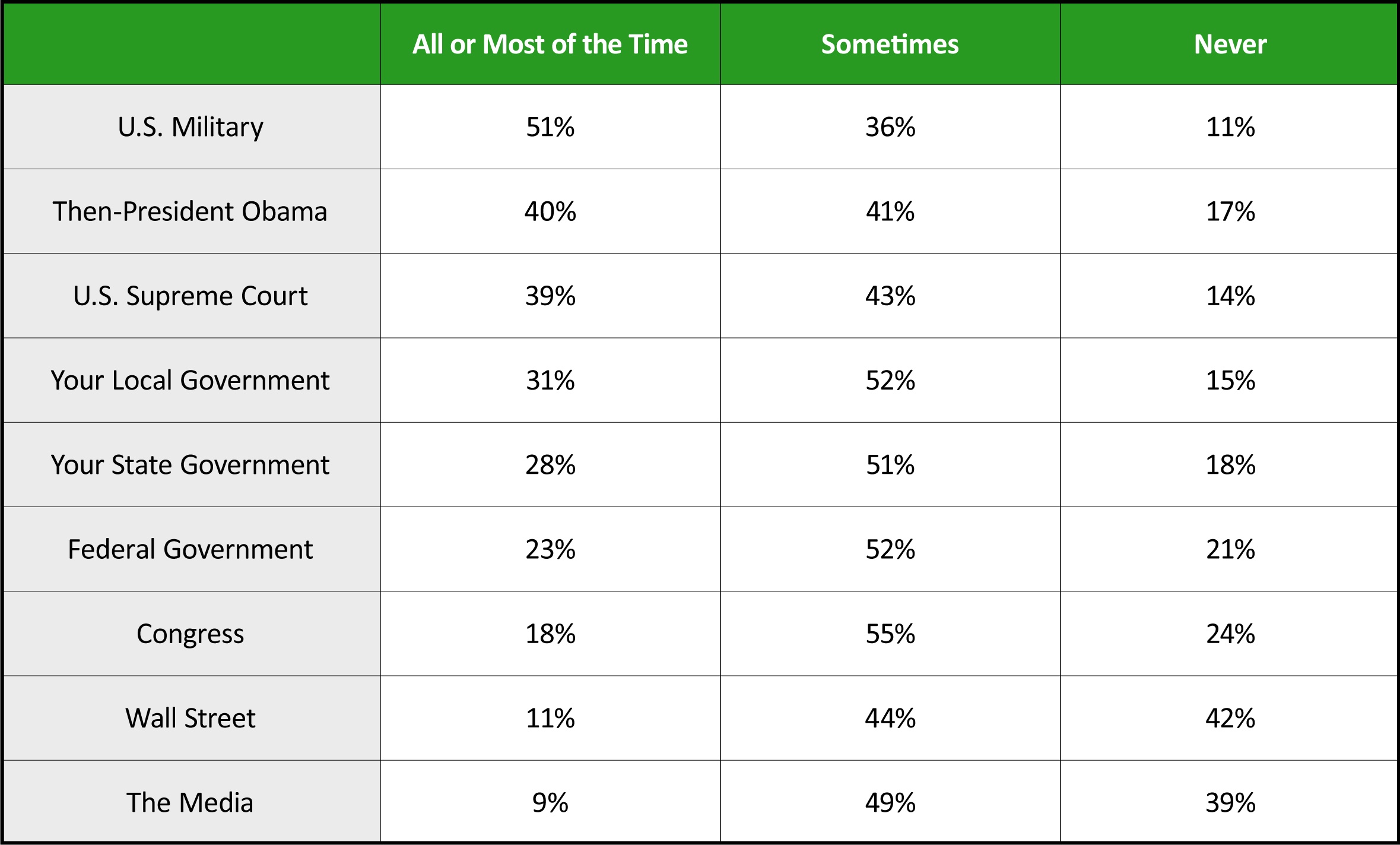
That’s the seemingly sorry takeaway from a Harvard University study of U.S. Millennials’ attitudes toward our society’s leading institutions. Focusing on 18- to 29-year-olds, the survey asked respondents to identify institutions they feel are trustworthy “all of the time,” “most of the time,” “some of the time,” or “never.” The U.S. Military was the only one that at least half of Millennials felt deserved their trust all or most of the time.


But in adversity lies opportunity. Brands and companies have a chance to lower Millennials’ shield of mistrust, if they can find the right messaging and provide products and experiences that deliver value and signal that they are authentic and real. Have something specific and relevant to offer and you can occupy the high ground of confidence, relatability and reliability that many big institutions have lost. And market research provides the crucial data to shine a light on which paths to take to that higher ground. If, that is, the research is done right – and, crucially, in a way that can engage those mistrustful Millennials who seem ready to tune out at the very moment they’re coming into their own as the dominant force in driving government, commerce, and social mores.


In a moment, you’ll see some ideas about how to cut through Millennial mistrust with Millennial-friendly research approaches. But first, here’s a grid showing what you’re up against – a Millennial mindset that seems to regard institutions’ messages and actions as suspect until proven otherwise.


From the 2016 questionnaire, here’s what Millennials said about trusting the following institutions to do the right thing:


TrustPoliticalGrid


Two things that do resonate with Millennials are rewarding encounters with technology and a belief in the wisdom of crowds. As Washington Post blogger Emily Badger phrases it, “I don’t trust you, Random Guy Giving Me a Ride Home, but I do trust the 4.9-star average rating of all the people who’ve been in your car before.” That’s because, for Millennials, it “is about trust between one person and the crowd.”


This is encouraging. It means you have good field position (to use a football metaphor) to score with Millennials. You just have to have the right game plan. Connect with them on the right devices and reward them with the right kinds of survey experiences, and you’ll get this wary generation of doubters and skeptics to trust you enough to give you the quality consumer data you need.  


Millennials are ready to trust and engage with your surveys if you show you’ve got the technological savvy to give them a smartphone experience they’ll admire and enjoy. The best true-mobile research technology can connect you with more than 700,000 Millennials who use the Surveys on the Go® app. They’ve certified their trust and engagement by giving the app consistent average ratings of at least 4.5 stars out of 5 (you can check out tens of thousands of unsolicited ratings and reviews for the Surveys On The Go® app by visiting its pages at the App Store and Google Play). To learn more about how you can connect with Millennial consumers for research that both parties can trust, just click here.


Topics: MFour Blog

Don't Let Millennials Block You Out. Reach 'Em with a Great Mobile Research Experience

Posted by admin on Feb 28, 2017 12:42:59 PM


MillennialAdBlockers_900x300


A new report by eMarketer says that mobile users are more than twice as likely to block advertisements on personal computers than on smartphones. It’s perhaps the ultimate testament to mobile dominance, and to the public’s eagerness for all kinds of experiences on their phones. If ads are welcome on mobile, what isn’t?


The eMarketer study of Americans’ ad-blocking behavior showed that 20.1% of pc users employ ad blockers, compared to just 7.9% of smartphone users. While Millennials are particularly intolerant of advertising on personal computers, far more are willing to accept it on their phones. eMarketer estimates that 41.1% of Millennials use ad blockers – but that the great majority of the blockers are deployed on personal computers rather than on smartphones.


It’s one more reason that market research, too, must be devoted to providing a rich smartphone experience. Why? Engagement is why. You have to give the people what they want – and they want good smartphone experiences. Mobile surveys can be among the most rewarding and engaging experiences for smartphone users, but that hinges entirely on knowing how to provide a satisfying experience. All mobile is not created equal, and only the most advanced, true-mobile research solutions will give you the panel engagement that's needed to drive fast and accurate insights.


A great way to get started is to try MFourDIY™ – the nation’s only do-it-yourself mobile research tool. It's your secret weapon for capturing vivid consumer insights. And we’ve made it simple for you to use. To learn more, please contact sales@mfour.com – and you’ll be on your way to delivering the type of mobile experience that panelists love.

Topics: MFour Blog

Your Mobile Approach Is All Screwed Up. Small Screens Drive Bigger Results

Posted by admin on Feb 27, 2017 10:05:23 AM


screwdriver_900x300


If your mobile research strategy is really screwed up, it might stem from believing the myth of the small screen. It was once thought that smartphone screens were ill-suited to consumer research because they’re too small to engage mobile survey respondents and elicit accurate reliable data. These smartphone denialists say it’s better to stick to online studies geared to desktops and laptops – sizeable screens that supposedly provide a better user experience.


There’s plenty of real-world data that busts this particular hot air balloon – with one caveat: like TV’s Mythbusters, contradicting a myth takes lots of experimental ingenuity to properly put it to the test.


Recent earnings reports suggest that Google, no stranger to technical ingenuity, is also busy exploding the small-screen myth. Which is only natural, given that Google’s phenomenal success stems in large part from satisfying the public’s enthusiasm for – make that the public’s insistence on – accessing all kinds of content on smartphones.

  • Forbes predicts that Google’s advertising revenue from mobile searches will reach $29 billion in 2017 – 26.6% higher than the $22.9 billion expected from Googling on personal computers.
  • The New York Times reports that Google commands more than 90% of search revenue from mobile devices.
  • And here’s a big reason why: “On smaller mobile displays, Google’s ads occupy a large portion of the screen – making it more likely a user will click on them.”

That last item says it all: the right kind of display on a smartphone screen doesn’t alienate. It engages. And it motivates interaction.


Smartphone surveys are a sequence of mobile interactions. As respondents move through shifting screen displays to receive and answer questions, smooth function is essential; so is an elegant display that’s clear and simple enough to command full engagement. And this leads us to another mobile myth that needs busting: the notion that all mobile is created equal.


Mobile research technology is not a commodity. It is not a generic, undifferentiated, one-size-fits-all utility. Rather than give you a step-by-step explanation, here are the two essential questions you should ask of any supplier of mobile survey technology and mobile panel:

  • “Will my survey be fielded with a native app that makes it truly mobile, or is the process you’re selling only adapting online methodology to a smaller screen?”
  • “Do your mobile surveys require a connection between the phone and the web?”

If the answer to both is that you’re getting an in-app process that loads the entire survey into a phone and requires no further web connection – then you’re buying glitch-free, true-mobile research and a fully-engaged panel.


But if the answer is a product tied to the mobile web, you’re buying all the hazards that go with smartphone web connections, including respondents losing connections in dead zones, and watching question downloads slow to a crawl. You’ll be buying a real risk that survey-takers will tune out at the first sign of a delay. Now your more mobile-savvy competitors will be laughing as they outflank you.


Google makes no such mistake. Sundar Pichai, Google’s chief executive, told the New York Times that beautifully functioning content such as its YouTube, Maps, and Google Play assets constitute “prime time in the mobile era.”


If you want prime time mobile research, the best way to get started is with MFourDIY™ – the only in-app, true-mobile do-it-yourself survey-building tool. You’ll see for yourself how mobile myths get busted – and you’ll stop screwing up your research and deliver more vivid results. For full details, just click here.

Topics: MFour Blog

Friday Roundup: Your Fastest Research Won't Add Up if You Neglect Quality

Posted by admin on Feb 24, 2017 9:45:24 AM


suckatmath_900x300


Here's your Friday roundup of 3 items from MFour to keep you up to speed on mobile research as you kick off your weekend.

And here's a Friday tune to send you smiling and prancing into your weekend.

Topics: Uncategorized

Subscribe to Email Updates

Recent Posts