admin

Recent Posts

Picture What You’ll Accomplish with Advanced Mobile GeoLocation Studies

Posted by admin on May 10, 2017 10:03:28 AM


GeoLocationMap_900x600


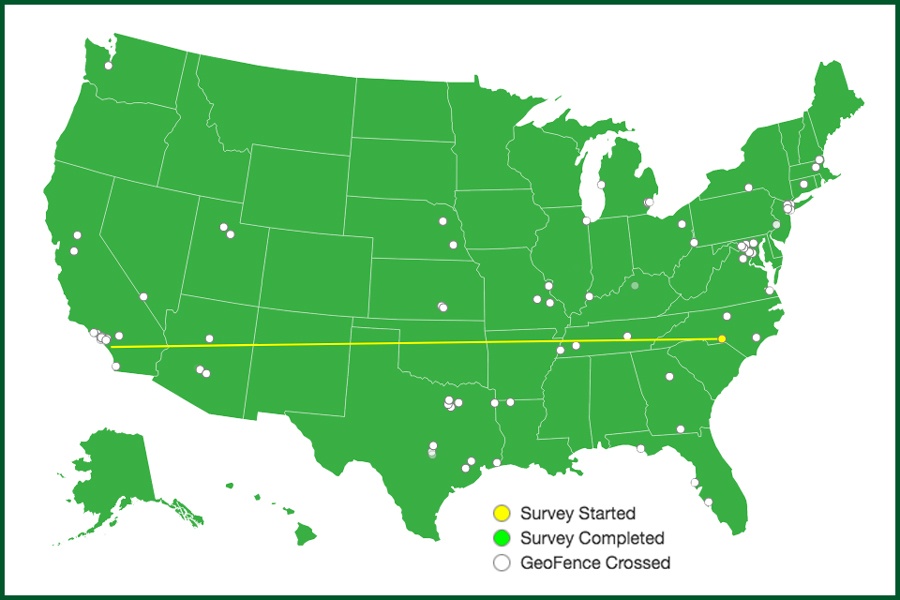
A picture is worth at least 1,000 words when it helps you visualize a concept. Today’s concept is mobile GeoLocation research. Here’s a description in 58 words:


GeoLocation studies employ GPS technology to locate members of a mobile panel when they enter or exit a retail store or other location relevant to a research project. Panelists who’ve crossed the “geofence” around each location receive push notifications through a survey app, alerting them to take a survey while they’re still shopping, or soon after they’ve left.


The picture you see above is worth many more words than that. It’s a screenshot of the real-time GeoLocation action map of the United States you’ll find by clicking here (scroll down after clicking to see the action map). You'll see  the moment-by-moment survey activity of the million-strong, all-mobile panel that uses the Surveys on the Go® smartphone app.


Each shooting yellow vector represents a survey just begun by a panelist, and each green vector is a survey just completed. But pay special attention to all the flashing white dots. Each represents a panelist naturally entering or exiting a geofence around a commercial location. Each geofence is a doorway to uniquely vivid, real-time insights from consumers who’ve been GeoValidated® so you’re sure you’re talking to them in the right place and at the right time. You’ll get insights from them at the Point of Emotion® – the moment of maximum import in their shopping journey when they’re not just thinking about purchasing, but fully feeling and acting on their agency as consumers. Picture what it would mean for you to be right there with them, via mobile GeoLocation.


You can access more than 400,000 U.S. locations that already have been geofenced -- or specify additional relevant locations, which can be geofenced quickly to meet the requirements of any location study. Geofences for locating Surveys on the Go® panelists extend from Alaska to Florida, from Hawaii to Maine, covering retailers from Abercrombie & Fitch to Zara, and every letter in between. So far we haven’t had a request to add a brand beginning with the Spanish letter “LL,” but we do have L.L. Bean.


For more information about mobile location studies, just contact us at sales@mfour.com.


Topics: MFour Blog

Learn How Geolocation Studies Validate Data and Bring it to Life

Posted by admin on May 9, 2017 9:24:46 AM


GeoLocationTravel_900x300

How valuable are consumer insights that provide the “what” without getting fully inside the “who,” “when,” and “where?”

The question arises from a recently-published case study that examined the fragility of brand loyalty in the face of hotly competitive pricing in the travel industry. The study attacked the question with an online survey of self-identified travelers who’d taken trips within the past six months.

Without questioning the findings about travelers’ brand loyalty – “not very” sums it up – it’s useful to point out how this kind of research can be decisively enhanced and enriched by using mobile GeoLocation. A GeoLocation study would pinpoint people who are traveling right now, instead of relying on respondents to make a half-year memory stretch. And all GeoLocated respondents are, by definition, validated to a certainty – because each one’s smartphone location signal is telling you exactly where you’ve reached them.

Here’s a basic outline of how GeoLocation studies work:

  • Put geofences around the locations that are relevant to your study – if you needed to talk to travelers in-the-moment, you might consider travel hubs, conference and convention centers and amusement parks. Any structure can be geofenced, as long as you can provide its latitude and longitude. Proprietary GeoIntensity® technology ensures state-of-the-art mapping accuracy.
  • Go with a mobile panel that’s large enough to achieve an incidence rate and completion rate sufficient for high-confidence data.
  • Panelists who cross a geofence to enter a travel hub or popular travel destination receive an immediate push notification, using a proprietary technology called GeoNotification®. Or, you can hold off and push the survey notification as soon as they cross the geofence as they leave the site.

Either way, you’re talking to people about an experience that’s foremost in their minds at this very moment, instead of asking them to think back weeks and months to recall what they did and what motivated their decisions. Mobile GeoLocation studies cut through the haze of memory decay and give you the clarity and emotion of right now. They take you into a fertile garden of insights about what consumers are thinking, feeling and doing, just when they’re thinking, feeling and doing it.

Does the idea of a research presentation that gives just the “what” and relies on long-range recall seem a little unreliable and bland? Mobile GeoLocation gives you the range and depth you need to make your research timely and vivid to the clients or bosses who are relying on your data and analysis to make sound business decisions.

To learn more, contact us at sales@mfour.com and we’ll set up a live demo at a convenient time.

Topics: MFour Blog

Use Mobile GeoLocation To Innovate in 2017 -- but Let's Give Props to 1920

Posted by admin on May 8, 2017 10:01:03 AM


GeolocationHistory_900x300


For nearly 100 years, location-based consumer research has been the gold standard for getting insights when they're red-hot. Now, in the Smartphone Era, in-location insights are even hotter, but considerably less complicated and expensive to obtain.


Location studies have come a long way since 1920, when a dozen researchers fanned out through the shopping district and surrounding neighborhoods of Sabetha, Kansas (pop. 2,003 at the time) to query townspeople for the publisher of popular magazines such as Ladies Home Journal and the Saturday Evening Post. They were on a quest for insights about how much bang these magazines’ advertisers were getting for their buck.


Today’s national or regional companies and brands can accomplish in-location surveys with just one researcher who’s sitting in front of a computer screen that might be anywhere. All it takes is advanced 21st century mobile GeoLocation technology that can pinpoint any phone’s whereabouts -- and, crucially, a quality, highly-engaged research panel whose members carry smartphones and are eager to be located and receive an in-app push notification. Today’s GeoLocated in-location or after-visit studies are direct heirs of that 1920 research posse that came to Sabetha armed with paper and pencils under the direction of market research pioneer Charles Coolidge Parlin.


History – or at least Stefan Schwarzkopf’s account in“The Routledge Companion to Marketing History” -- doesn’t specify what the Sabetha researchers found out about magazine advertising’s efficacy in rural Kansas. But we’re pretty sure that future volumes on the history of market research will have plenty to say about GeoLocation studies.


For decades, paper and pencil, or clipboards and pens, brought research face to face with shoppers in the store aisle or outside the entrance. The result was data about the in-progress or just-concluded shopping experience that set a gold-standard for reliability at the time. But the encounter between a clipboard researcher and an interviewee came with an inescapable potential for bias that's inherent in any human-to-human interchange. Variance between researcher's personalities, training and consistency in asking survey questions can distort the results.


Mobile GeoLocation puts the answers solely (and literally) in the respondents’ hands. Like researchers with clipboards, the lone survey programmer at a desk can identify shoppers when they enter or exit a retail store, cinema, restaurant, or other location that’s relevant to the project at hand. The objectives will be more or less the same as they were in 1920: insights into shoppers’ motivations, actions, thoughts and feelings at or just after the moment of truth. Except that in 2017, smartphone multimedia extends those capabilities and captures a new dimension in vivid insights. Audio and video can easily be embedded with survey questions, or created by respondents at the researcher's request.


We’ll be sharing more about location-based research in this week’s posts, so please stay tuned. But if you’re one of those insights professionals who’s impatient to learn and explore, there’s no need to wait. Please get in touch right now by clicking here. We’ll set up a live, one-on-one demo session that will walk you through how you can achieve today’s gold standard in GeoValidated® research.


Topics: MFour Blog

Learn Why 'Mobile Optimized' Surveys Are Sub-Optimal

Posted by admin on May 5, 2017 10:08:22 AM

MobileOptimized_900x300


Here's your Friday roundup of 3 items from the MFour blog to keep you up to speed on mobile.


Why "Mobile Optimized" Surveys Are Sub-Optimal


Taking the Paddle to Online Panel


Taming the Wild Frontier of Mobile Ad Metrics


And here's a Friday tune to get you hopping into the Cinco de Mayo weekend.

Topics: MFour Blog

Rob Chrone Joins MFour’s Team as Chief Financial Officer

Posted by admin on May 4, 2017 9:15:05 AM


NewHireRobChrone_900x300


Rob Chrone has joined MFour’s team as Chief Financial Officer, bringing 20 years’ experience as a financial and operations executive at growing technology companies. Rob’s previous positions include Chief Financial Officer for Vantage Media and CFO and Chief Operating Officer at email security company FrontBridge Technologies. He’s played key roles in raising investment capital and in mergers and acquisitions, including Microsoft’s acquisition of FrontBridge. Rob is a certified public accountant and holds a Bachelor’s degree from Stephen F. Austin University.  His arrival at MFour continues the company’s rapid growth, which recently has received endorsements from both the private sector ($5 million in new funding from Kayne NewRoad Ventures Fund II) and the public sector ($680,000 in job-creation tax credits from California’s state government). Rob said he’s particularly excited because “MFour offers a differentiated market research platform and has been growing rapidly. Client demand is strong and increasing. It should be a fun ride.”


Welcome aboard, Rob!


Topics: MFour Blog

Learn How Innovative Mobile Technology Solves the Panel Quality Crisis

Posted by admin on May 3, 2017 9:26:30 AM


BlogPanelQuality_900x300


Desperado, why don’t you come to your senses?


With apologies to the Eagles, this isn’t just a question to kick off a classic rock ballad about a lonely guy who’s afraid of commitment. It’s a question that many market researchers need to ask as they try to deal with the continuing decline of online panel quality.


We’ll be periodically highlighting why issues of panel quality and consistency have reached the point of desperation – as demonstrated by the wake-up calls issued by the authors of the two most recent editions of the GreenBook Report on Industry Trends (GRIT). And we’ll be calling your attention to a solution to the problem, by going through the best practices for innovating your way out of the bad-data desert. The solution lies in advanced, in-app research technology that gives survey respondents the high-quality mobile experiences today’s consumers demand.


To start, here’s the context for why it’s crucial to focus on panel quality and the best practices for achieving it.


The 2016 Q1-Q2 edition of GRIT found a striking disparity between how panel providers perceive their product’s quality, and how it looks to their clients. The clients, it should go without saying, are the best judges of whether the data they obtain from online panels is reliable enough to let them do their job of generating insights that can stand up to a reality check in the real world of business decision-making.


The bar graph on Pg. 44 of the report says it all. More than half of the data collection providers GreenBook surveyed, and nearly half of the sample providers, said panel quality is getting better. But it was just the opposite for insights professionals who have to tease meaning out of data and provide analysis that can withstand a reality check. Barely 20% of GRIT respondents from full service MR firms, and fewer than 20% of corporate research insights professionals, saw an improvement in panel quality. More than 40% said survey sample was getting worse. In other words, those who have a vested interest in obtaining quality data are getting desperate, while those who are supplying it want the industry to think everything’s still peachy.


Here’s the key insight GRIT’s authors distilled from their respondents’ comments:


“Surprisingly, [insights professionals think that] technology, or lack thereof, is the prime culprit for sample getting worse: from bots, to survey design, to mobile enabled surveys, all these are driving sample quality down. Many respondents have a strong sense that there are only professional survey takers and fraudulent bots that are taking all the surveys because there is a race to the bottom in terms of cost.”


Are there any more damning words when talking about technology than “lack thereof?” When it comes to success in market research, or any other 21st century business, there’s no margin of error when it comes to getting the technology right. What’s crucial to understand is that it’s a fatal mistake to view panel and survey technology as separate, independent and unrelated inputs. Successful research depends on five core insights into how the consumers you need to engage experience technology:

  • Consumers use smartphones for their personal activities; desktops and laptops are devices for the workplace.
  • Consumers don’t just use smartphones – they view them as necessary appendages to perceiving, thinking, expressing and acting.
  • Consumers don’t merely dislike having slow, cumbersome experiences on their phones. They simply won’t tolerate them. Research must be mobile, and its design and delivery must sparkle.
  • Consumers' first choice for mobile experiences is to access them through apps, not browsers and web connections that are vulnerable to dropped connections and other problems that compromise functionality and lead to frustration and disengagement.
  • Successful research is impossible without the right incentives. One is fair cash payments for honest, thoughtful survey responses. The other is an engaging technological experience – a reward in its own right for today’s mobile consumers.

Act accordingly, and soon you won’t have to feel like a desperado when your research data comes in. As we periodically revisit this subject, we’ll be going into more specifics on how panel quality and innovative mobile research technology have become intertwined in a double-helix that needs to be part of the research industry’s DNA. If this makes sense to you, you’re invited to get full details on the best practices right now. Just contact us at sales@mfour.com.

Topics: MFour Blog

Why "Mobile Optimized" Is Just Yesterday's Buzzword

Posted by admin on May 2, 2017 10:06:50 AM


InAppAdvertising_900x300


Ever wonder why market research breeds buzzwords – “agility,” "mobile optimization" and “gamification,” for example? In a bid to coin a new one (which you’re invited to ignore at will), we propose “propinquity.” There may not be an odder word in the dictionary, but its meaning lies at the very heart of our industry: “the state of being close to someone or something; proximity.”


One of the most important tools for achieving propinquity (or, if you insist on plain English, “a connection”) with consumers is the smartphone app. According to comScore, 61.7% of Americans’ time in digital space is devoted to mobile apps. Where the people are is where businesses must go -- including consumer research. Surveys don't need to be gamified if they take place inside a quality, user-friendly mobile app that meets consumers in their comfort zone. The name of the game for engaging them is innovative app technology that exploits what apps are all about -- eliminating the need for the web connections and email notifications that keep "mobile optimized" research tethered to last-generation technology.


Here’s a quick how-to on one important new use for in-app research: measuring mobile ad campaigns that now account for $36.6 billion in annual U.S. spending. It involves a nationwide bank's bid to promote its mobile banking app with mobile advertising geared especially toward Millennials, a generation that typically spends a lot more time with financial technology smartphone apps than in propinquity with a teller's window.

  • First, seek out a representative research panel that takes surveys via a mobile app. Members can be consistently and efficiently targeted by the detailed demographic data they provide when they first download the app.
  • Understand the importance of mobile Advertising IDs. To measure mobile ads, you need to know which phones have received them. Each smartphone has a unique ID, and advertisers have access to the ID code for each phone on which an ad was displayed.
  • Match the universe of all Ad IDs collected in a campaign against the IDs of mobile panel members. Bingo! Each match is a validated ad recipient you can survey.

Some advertisers may just want aggregated demographic data that makes it clear whether the ads are being targeted properly to the likeliest or most-desired profiles of consumers. That alone can inform useful business decisions about improving targeting and eliminating wasted spending. In this case, the banking client wanted deeper insights that required surveying 200 ad recipients representing preferred consumer demographics. The bank knew it would be talking to just the right people about whether they were aware of its app and its in-app advertising. Other questions dug for insights into perceptions of the bank’s brand and services – and its competitors’.

  • To measure the campaign’s effectiveness, a mobile survey was sent to a demographically comparable control sample of panelists whose phones had not received the bank’s mobile ad. The bank found that ad recipients’ brand awareness was 12% higher than among non-recipients.

The moral of this story is that you shouldn’t waste any brain cells remembering “propinquity” or any other buzzwords, but you need to grasp that the standard for innovation, quality and consistency is in-app mobile research.


Interested? Take the first step to mobile ad measurement and brand research by contacting us at sales@mfour.com.


Topics: MFour Blog

$36.6 Billion in Mobile Ads Make Valid Measurement a Must

Posted by admin on May 1, 2017 10:20:18 AM


MobileAdMeasure_900x300


How can we measure the boom growth in mobile advertising?


Well, we can run the aggregate numbers: a new report from the Interactive Advertising Bureau says that marketers in the U.S. spent $36.6 billion on mobile ads in 2016. For the first time, ads delivered to smartphones and tablets accounted for more than half of all digital ad spending.


You can look at percentage growth: annual mobile ad spending rose 76.8% over 2015 – accelerating the already stupendous growth rate of 65.6% between 2014 and 2015.


Or you can break it down to the human-sized dimension of per capita ad spending. Advertisers spent an average of $39.32 per American in the mobile realm during 2014, $64.41 in 2015 and $112.92 in 2016. Meanwhile, eMarketer estimates that mobile ad spending will reach $50 billion for 2017 -- a 36.6% growth rate. 


It's easy to understand why mobile advertising is taking off -- that's where consumers are; therefore, it's where marketing must be. But do advertisers really know how well their campaigns in the new mobile frontier are doing? 


Until now, there hasn’t been a clear answer to that. But given the rising stakes, advertisers can’t afford to be foggy about whether those billions of dollars are hitting the bullseye and driving consumers along the path from awareness to interest to purchase.


There is, in fact, a way to cut through the fog – a research method that’s intrinsic to the same phones on which all those ads are appearing. Each phone has its own distinctive Advertising ID, and researchers who use Ad IDs will acquire a beacon of clarity through the fog. By following best practices in mobile ad measurement, advertisers can learn whether they’re getting the most from the goldmines they’re staking on smartphone users getting the message.


Stay tuned for more tomorrow on how you can access the advanced technology and best practices that MFour is pioneering to measure the effectiveness of mobile ads. And if you just can’t wait, that’s OK – feel free to get in touch right now at sales@mfour.com to set up a one-on-one demo at a convenient time.

Topics: MFour Blog

Get Saved! Hear the New Gospel on Panel Quality

Posted by admin on Apr 28, 2017 10:10:55 AM


FridayRoundupPhones_900x300


Here's your Friday roundup of 3 items from the MFour blog to keep you up to speed on mobile.


Get Saved! Hear the New Gospel on Panel Quality


Measurement Should Never Be a Guessing Game


Learn the Best Practices in Mobile GeoLocation Studies


And here's a Friday tune to get you floating into your weekend.

Topics: MFour Blog

Best Practices: Use Mobile GeoLocation for OOH Ad Measurement

Posted by admin on Apr 27, 2017 11:00:05 AM


CaseStudyOOH_900x300 

What’s the best way to measure ad lift from out-of-home ad campaigns? Here’s a case study showing how it can be done using an advanced, all-mobile approach. The key is to harness technology that allows researchers to locate and push surveys to panel members when their smartphones’ GPS location function signals that they’ve come within a short distance of OOH signage. It's an innovative alternative to the guesstimates you may have been relying on, derived from traffic counts and other methods that massage second-hand data. The mobile approach lets you  access actual, GeoValidated® passers-by who definitely were exposed to your signs, moments after they've come within view of them.


The Challenge

A global information and entertainment channel wanted to test an outdoor advertising campaign for a new content-streaming app targeted primarily at Millennials.


The Solution

First, use geofencing and proprietary GeoIntensity® technology to "map" more than 130 billboards in three major U.S. cities on which the ads for the new streaming app were mounted. Once the billboard campaign began, panelists ages 18-34 received push notifications as soon as they came within 80 meters of one of the mapped signs.


Note:  It was  important for best practices that the survey be conducted with an app that panelists have downloaded. The alternative to innovative in-app mobile research is the far less reliable "mobile optimized" method that requires smartphone users to access an online survey by clicking on a link. This creates connectivity issues that can slow the process, causing drop-offs and other problems that compromise data quality.

  • To measure lift, a baseline had to be established before the campaign began. It was done by surveying control groups of respondents who were not exposed to the campaign.
  • In this case the control groups consisted of 300 panelists in three cities that did not receive any out-of-home (OOH) advertising of the new app — and 300 panelists in the three campaign cities who also had not seen the new advertising because they were surveyed before the campaign began. The unexposed control panelists and the control cities were demographically similar to the campaign panelists and the campaign cities.
  • Once the campaign began,100 completes were collected from ad-exposed panelists in each of the three cities.
  • Fielding aided by proprietary GeoNotification® technology was sequenced to collect 20 completes per week in each city over five weeks. This allowed measurement of the OOH ads’ cumulative impact as the campaign progressed.

The Results

Awareness was approximately 20% higher in the three test cities than in the three control cities. Respondents surveyed in the fifth week of the campaign were 5% more likely to be aware that the new app was on the market than was the case for respondents who’d been surveyed after being exposed to a billboard in the first week of the campaign.


The Outcome

The client learned with confidence that its OOH campaign was having its intended effect with the Millennials it was targeting. The study also gathered data about respondents’ intention to use the app and their perceptions of how the client’s app compared to its competitors. Insights from the study could now inform the client’s marketing strategy for the app.


There's a lot more to talk about when it comes to best-practices for OOH ad measurement, or for any other type of survey that can benefit from mobile GeoLocation that identifies panel members when they arrive at locations crucial to your study. Just contact us at sales@mfour.com, and we'll set up a one-on-one live demo session.

Topics: MFour Blog

Subscribe to Email Updates

Recent Posts