

admin

Recent Posts

83.7 Million Millennials Are the Keys to Your Future

Posted by admin on Dec 29, 2016 10:12:37 AM

Key to Future


In business, knowing your Millennials is as important as knowing your ABC’s in kindergarten. Failing to master this skill is simply not an option.


It’s a big task, getting to know 83.7 million Americans. And it’s complicated by the fact that the era of the Millennial is also the era of fractured information and communications. Baby Boomers grew up with three commercial TV networks and perhaps a handful of local channels. Millennials grew up with YouTube, Facebook, and Twitter, which invite anybody and everybody to be a broadcaster or a publisher.


Another complication: Millennials are the second-most diverse generation of Americans, ever – exceeded only by those born after 2000, the post-Millennial Generation Z.


To get some big-picture insights, let’s run some statistics from the U.S. Census Bureau’s 2015 population estimates.

  • The Bureau defines Millennials as people born between 1982 and 2000 – that is, Americans who will celebrate their 17th to 35th birthdays in 2017.
  • The 83.7 million Millennials, many of whom have entered their prime spending years, outnumber the 75.4 million Baby Boomers – most of whom are beyond or on the verge of turning 60.
  • 44.5% of Millennials identify as what are commonly understood to be minorities, rather than as what the Census Bureau calls “non-Hispanic whites.”
  • In the post-Millennial generation, ages 15 and under, 49% are minorities – and that percentage is likely to grow by 2019, when Gen Z will finish being born. Z-ers who arrived on the scene from 2010 to 2014 are 50.2% minorities.
  • The key insight for market research is that it absolutely must gain a diverse understanding of these unprecedentedly diverse generations. Wholesale generalizing won’t do for businesses striving to realize real success.

The one useful, generation-defining generality to be drawn about Millennials and Gen Z is that if you look at their hands you’ll see a smartphone. More than 80% of Millennials have them, according to the Pew Research Center, and the number rises to 86% for Millennials under 30.


True-mobile research lets you respond to that core fact about Millennials. It harmonizes the research experience with the Millennial and post-Millennial insistence on smartphone experiences that hold their interest and provide rewarding encounters with smoothly-functioning technology. There’s just one technical concept you need to understand before you start sending surveys to Millennials, and that’s the difference between mobile apps and the mobile web.

  • In true-mobile surveys, the experience takes place entirely within an app, from push notification through completion. The survey loads instantly in a respondent's phone, eliminating the need for an  uninterrupted internet connection to receive and answer questions.
  • Online surveys that mobile respondents access via the mobile web require cumbersome e-mail notifications, followed by an even more cumbersome back-and-forth exchange between the website that houses the survey and the respondent's smartphone. It's a recipe for slow performance, frustrated respondents, disengagement, and suspect data.
  • It’s the elegance and smoothness of the app experience that accounts for the fact that smartphone users now spend more than three hours a day with apps, and just over 20 minutes, on average, using their phones’ web browsers, according to Flurry Analytics.
  • If you go looking for Millennials where they are – on their smartphone apps – your chances of finding the numbers and demographic quotas you need will soar. 

Click here for MFour panel demographics that show just who you’ll reach when you reach out to more than a million active members who use Surveys on the Go® – the nation’s only true-mobile research app.


A fast and cost-efficient way to explore true-mobile research is to try MFourDIY™ – the only app-centered, true-mobile DIY alternative. For details, please visit mfourdiy.com or contact Alex at acolao@mfour.com.


Topics: MFour Blog

A National Grocery Chain Bets on Millennials in the Smartphone Era

Posted by admin on Dec 28, 2016 10:18:42 AM


wholefoods-blog-28dec16


One of the big retail stories of 2017 will be how shoppers – and most particularly, Millennial food shoppers – respond to the rollout of 365 By Whole Foods. The initiative, launched during 2016 in select locations, seeks to hit Millennials in their sweet spots by tailoring how Whole Foods delivers on its well-established brand identity as a seller of healthy, eco-friendly edibles. “New stores will be popping up all over the place in 2017 and beyond,” the “365” website promises.


Here are some of the key changes that could hold a special appeal for Millennials:


Technology Matters: Price labels will be digital only, and iPad-like devices will let shoppers place takeout food orders that will be waiting for them at checkout.

  • This taps into a signature preference of Millennials, for whom tapping smartphones to access information and carry out the tasks of daily life is second nature.
  • And that extends perhaps even more to the younger Gen Z that’s beginning to come of grocery-shopping age.

Speed Matters: Technology and standardized store design aim to accelerate the shopping experience.

  • Millennials are accustomed to going from experience to experience rapidly in the mobile realm.
  • Some say that’s a sign of short attention spans – but it also underscores the fast, multitasker’s pace at which Millennials are accustomed to getting things done, shopping included.
  • Today’s grocery retailers have to compete with online shopping and food-delivery options that Millennials also favor. So delays can’t be part of the in-store experience.

Thrift Matters: A core proposition for 365 By Whole Foods is lower pricing attained through operating efficiencies, and a standardized, utilitarian, no-frills store design.

  • As the generation that came up during and after the Great Recession, Millennials are well aware of economic challenges and seek ways to adapt or overcome.
  • A generation that doesn’t see big screen monitors, powerful stereos, landline telephones and cable or satellite TV subscriptions as necessities could be a natural audience for minimalist-chic store design and other features that underscore unpretentiousness and cost-savings through technology and efficiency.

Social Interaction Matters: Whole Foods invites local boutique restaurants and vendors to take up residence inside its “365” stores – hoping they will become social hangouts.

  • It’s often noted that many Millennials like hanging out face-to-face in groups; social media isn’t the only way they keep in contact with friends.
  • A grocery that’s technologized and standardized for efficiency-optimization, combined with opportunities for human-to-human, distinctly local hanging out seems like a bid to appeal to different sides of complex Millennial mindsets.

Whole Foods’ interesting bet on a Millennial-tailored grocery chain resonates with the idea that the realm of mobile technology is not something alien to in-person consumer experiences. It’s an early example of how the physical world of commerce will adapt to smartphones by recognizing how much Millennials'  intimate connection to their phones shapes their lives -- including their lives as consumers.


In the case of 365 By Whole Foods, a decades-old grocery chain rooted in a regard for nature is adapting to align itself with both the firm realities and stylistic sensibilities of the smartphone era – that is, it’s adapting to the rise of the Millennials and the even more tech-native generation coming up behind them. The best way to understand what young consumers think about 365 By Whole Foods -- or any other product or service -- is to ask them.


To find out how you can use MFour’s true-mobile research solutions to connect with Millennials, go to www.MFour.com or contact Alex at acolao@mfour.com.


Topics: MFour Blog

Make 700,000 Millennials Your Roadmap to the Future

Posted by admin on Dec 27, 2016 11:16:50 AM


keepmoving-jpg


Millennials are on the verge of becoming all grown up—all 83.7 million of them. And of course, that makes them the most important focus for businesses. Millennials are a national obsession, subject to more analysis, commentary, and off-the-cuff generalization about their attitudes and actions than any other group of Americans.


Marketing success depends on making accurate conclusions grounded in data. Off-the-cuff thinking won’t cut it. Perhaps the only useful generalization about Millennials is that nearly all of them have smartphones. At least 86% of those under 30, and at least 83% of those 30 and over are smartphone users, according to 2015 data from Pew Research Center.


Interface with them on their phones for market research, and you have a chance to understand them more accurately. But there is a further distinction to be made. Not all mobile market research is the same.


Research professionals acknowledge that the online survey methods that have long prevailed no longer work. They can’t reach enough of the right people at the right time – and that’s because online surveys and smartphones simply don’t mesh. Asking respondents to use their smartphones to connect with the Internet to take an online survey is like asking a Ferrari driver to stick to the speed limit on an open road with no other cars around.


A figure published by Flurry Analytics points the way forward: Americans average three hours and 40 minutes a day on their phones, and 90% of that time is spent using mobile apps. True-mobile research is app-based research. Americans have voted with their fingers – they’re tapping on apps. It’s how they like to use their phones. It’s what Millennials, in particular, find most appealing.


So how do you reach them in a way that matters to your business? MFour’s true-mobile surveys are driven by an app, allowing respondents to answer your questions in the way they most prefer. By reaching them where they really live (or shop), you’ll get vivid insights into their thoughts, feelings, and preferences.


Millennials constitute 70% of the more than one million active panelists you’ll connect with on the Surveys on the Go® app. Reward Millennials with a true-mobile smartphone survey experience, and they’ll reward you, too – with the business insights you need – now, and in the decades to come.


To learn more about the only app-centered, true-mobile platform, please visit www.mfour.com or contact Alex at acolao@mfour.com.


Topics: MFour Blog

Breaking News: Santa Claus Located Using GPS Technology

Posted by admin on Dec 23, 2016 11:12:12 AM


santa-blog-post_v2


Santa Crosses Geofence After Commissioning Study on Shopping Mall Santas


A new study by MFour Mobile Research reveals that shopping mall Santas receive high customer satisfaction ratings for their cheerfulness, patience with frightened children, and beard authenticity. But respondents say that in certain cases, mall Santas’ personal hygiene leaves room for improvement. The client for this study was the real Santa Claus, who needed insights into customer satisfaction with his surrogates at 1,200 U.S. malls.


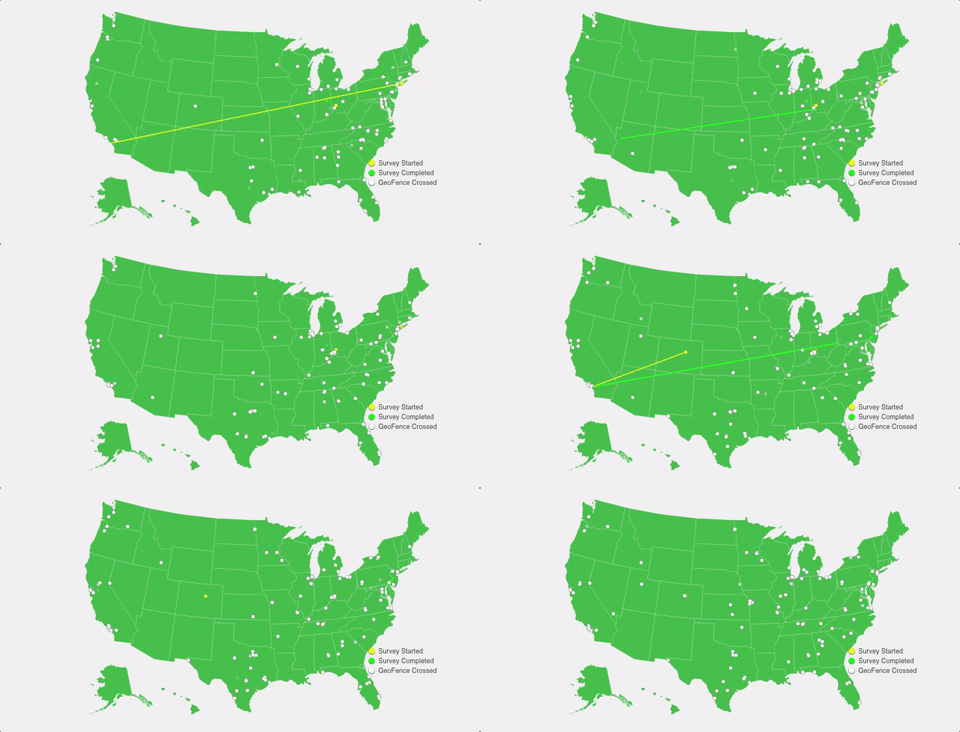
Mr. Claus commissioned a GPS-enabled geolocation survey in which MFour geofenced each of those malls (see real time map below). We then pushed surveys to natural mall-goers on our million-member, all-mobile active panel who are parents of young children. We got the 1,000 completes Santa required within a day of fielding – pro bono, of course.


Mr. Claus said the insights are driving a new initiative in which his elves will distribute lightweight, sweat-resistant Santa costumes to every surrogate by next Christmas season. The real Santa, who uses a smartphone like everybody else, has joined MFour’s Surveys on the Go® panel, enabling us to track him and the reindeer as they cross custom-geofenced areas.


geofence-map


To find out what attracted this illustrious client, of whom we’re exceedingly proud, just click here. And welcome to our panel, Santa! Thanks for being such a great client. Here’s to a Merry Christmas for one and all!


And here’s your Friday tune to put you in a holly jolly holiday mood. Enjoy!

Topics: MFour Blog

7 Mobile Insights into What’s Crucial for Research in 2017

Posted by admin on Dec 22, 2016 11:30:47 AM


7-insights_v2


Looking ahead to 2017, the panel crisis in market research is certain to remain one of the industry’s most important focuses. The most recent GreenBook Report on Industry Trends (GRIT) described the online panel crisis as “an existential threat” to consumer research. Without a new strategy to engage quality panelists, the report said, survey-based approaches will enter a “death spiral.”


Survey providers noticed – SurveyMonkey, for one, announced a new move into analyzing data from mobile apps, aimed at business clients. “Mobile will be the leading platform in which businesses connect with customers,” SurveyMonkey’s CEO said at the time. Mobile is winning – and it’s winning big. In fact, GreenBook characterizes mobile research as “mainstream,” with its latest survey showing that mobile is in fact the most-used method – used by 75% of respondents. Online communities were a distant second – used by 59% of respondents.


It’s well established that traditional online research methods are failing to capture accurate insights from a mobile-centric consumer base. So-called “mobile optimized” surveys that attempt to shoehorn online survey formats onto mobile screens are no solution. They don’t have the seamless functionality of app-based true-mobile surveys – and without seamless functionality, there’s no hope of making a trusting, one-to-one connection with real mobile consumers.


When done right, on the other hand, the true-mobile approach extends the great traditions of market research and allows them to thrive in the smartphone era. Consider the following:

  • Big Data about mobile use or social media use isn’t enough. To truly know consumers, you have to ask them what they’re thinking and feeling, instead of solely relying on Big Data insights on broader behavioral patterns.
  • “90% of Time on Mobile is Spent in Apps,” says a study by Flurry analytics. In other words, trying to conduct online surveys via mobile is like trying to catch fish in a puddle. App-based true-mobile research puts surveys in harmony with the ways in which consumers want to receive and exchange information on their phones.
  • Getting consumers to engage with surveys so that they will tell you what they think and feel is no easy matter. Failure to engage is what’s killing online surveys – and it’s not just poor survey design, but a case of operating in entirely the wrong sector of the information/communications universe.
  • Engaging consumers on mobile is the obvious solution, but it’s extremely hard to do. SurveyMonkey’s insight earlier this year that mobile apps are the gateway to important consumer data was on target, but the postscript is that the company recently announced it was abandoning its mobile data initiative after just eight months. Execution and relevance to clients’ needs are crucial – and take years of technological effort to perfect.
  • The problem isn’t that consumers are impatient with mobile surveys. It’s that they’re downright dismissive of any experience on their phones and with their apps that doesn’t live up to their extremely high expectations of smooth-functioning elegance and convenience – the qualities that make using their phones so appealing in the first place.
  • So-called mobile solutions that simply usher smartphone users to a website where a survey is housed will not provide the true-mobile experience that’s a must for productive research engagement.
  • The only way to get the reliable and representative sample that eludes online surveys is to use the right technology, which means harnessing a native app that embeds the survey experience instantly in the phone itself and allows respondents to answer offline.

A good, fast, and cost-efficient way to explore true-mobile research and compare it to the online-centered mobile you may be using now is to try MFourDIY™ – the only app-centered, true-mobile DIY alternative. For details, please visit mfourdiy.com or contact Alex at acolao@mfour.com.

 

Topics: Uncategorized

14 Thoughts on Removing Barriers to In-Store CPG Insights

Posted by admin on Dec 21, 2016 1:31:06 PM


shopper-insights_cpg


You’d be surprised how many people know some Latin – specifically the phrase, “caveat emptor.”


It means “let the buyer beware.” But a newly-released Pew Research Center study on consumers’ in-store use of mobile devices suggests that “caveat emptor” no longer reflects reality. “Caveat venditor” should be the new watchword – “let the seller beware.”


Smartphones have shifted the balance. They are history’s best shopping advisors.

Everybody has one, and that leaves brands no room for error. If a product’s quality, packaging, messaging, or customer value is dipping, shoppers checking their phones will know it in a flash exactly when they’re making up their minds, and will act accordingly.


The good news for brands and marketers is that the same smartphones that arm shoppers with unprecedented information can do the same for them – if they leverage phones’ vast capabilities with true-mobile consumer research. Pew Research Center recently published a study that lays out the new mobile landscape of in-store shopping:

  • 59% of U.S. adults report having used their phones while in a store to call or text someone to get buying advice.
  • It’s also common now for shoppers to go online from the store aisles – 45% of Pew’s respondents said they had used their phones to look up product reviews or gather other information about a potential in-store purchase, and 45% said they’d made price comparisons with their phones.
  • In the 30-49 age bracket, 72% reported calling or texting someone for buying advice, 62% said they’d looked up product reviews with their phones, and 61% had made price comparisons.
  • Among 18-29 year olds, 68% called or texted for advice, 63% looked up reviews, and 64% did online price comparisons.
  • Despite predictions that online shopping eventually will doom physical stores, Pew found that a solid majority of Americans still relishes the real-time, in-person shopping experience; 65% of respondents who had bought things online said that going to the store was their first choice.

And why not? When they go to a store, their phones give them the best of both worlds – the ability to eyeball real merchandise, augmented with instant e-commerce alternatives if what they’re seeing live isn’t appealing.


To understand this information-rich landscape for in-store shoppers, you need insight-rich data that only smartphones can provide. You can turn consumers’ phones into your own data source and your own valued advisor.

  • The location feature on every smartphone makes it possible to talk to shoppers while they’re in the very act of deciding what to buy.
  • Respondents receive an in-app survey that embeds in their phones, removing the need for an online connection.
  • You can choose to reach shoppers in-store, or wait and send them an after-visit survey they’ll receive right when they leave, using GPS-enabled technology.
  • You can ask about all tangible aspects of the shopping experience – shelf placement, packaging, in-store messaging.
  • You can get inside shoppers’ minds when their focus on your product category is most intense.
  • You can identify your product’s natural buyers and follow up with an in-home product evaluation study.
  • Knowing that shoppers are using their phones to make in-store buying decisions, you can ask them about the information they’re collecting -- and in what ways they are using it.
  • Smartphone users love to receive pictures and videos – so why not enhance or frame your survey questions by sending visual elements?
  • They also love to create and share pictures and videos. Ask shoppers to talk about their experiences and preferences in a selfie video, and you’ll achieve studies that have a vividly illuminating qualitative dimension.

The Pew study underscores that while smartphones have improved and expanded the in-store shopping experience, shoppers’ goals and desires are the same as ever: good value for a good product. In the same way, the traditional aims of survey-based market research remain unchanged.


To learn more about how you can leverage smartphone capabilities to get deeper consumer insights, visit www.mfour.com or contact Alex at acolao@mfour.com. And let the seller rejoice!
 

Topics: MFour Blog

A Toast to Accurate Consumer Insights

Posted by admin on Dec 20, 2016 1:53:47 PM


glasses


In this season of conviviality and good spirits, the classic bartender’s query, “What’s your drink?” has special resonance for a major consumer product – alcoholic beverages. It’s a crucial question for brewers, vintners, and distillers everywhere, because it’s what consumers are asking themselves as they shop for potable gifts – or for drinks to pour at holiday gatherings. Each shopping stroll down the alcoholic beverage aisle is an opportunity that can’t be missed.


Right now, whiskey seems to be hot. Quoting International Wine and Spirits Review, MediaPost reports that sales of American whiskey have grown more than 40% over the past decade to about $3 billion, with another 20% growth spurt forecast in the coming five years. Why is this happening? Who’s doing the drinking? And what can bottlers of vodka, tequila, and gin do to tilt the answer to “What’s your drink?” more in their own favor?


The location feature on every consumer’s smartphone now makes it possible for researchers to sidle right up to the bar or the liquor store shelf and ask “What’s your drink?” – or any other question that will shine a light on what people think and feel when they’re in the market for alcohol.


With the MFourDIY™ platform, you can now send these beverage-seeking consumers in-location or after-visit surveys that catch them at the Point of Emotion® – the key moment when a purchasing decision is made. The same goes for any other product. You’ll locate natural shoppers at national or regional retail locations, then use their phones to sidle right up and ask about their brand preferences and shopping experiences when it matters most.


So how do you make it work for your product? It starts with GPS-enabled GeoValidation® to certify that a shopper is indeed inside a major store that carries the product in question. Next, you can question shoppers about your product or ask them to shoot video selfies in which you’ll see and hear them answer your questions in their own words. Respondents’ unmediated facial expressions and inflections of voice become part of your data set and help drive particularly revealing insights. Reliable data is crucial, but seeing and hearing makes the numbers come alive.


Give in-store and after-visit product studies a try and you’ll be lifting a toast to what you’ve accomplished. What’s your drink? Whatever your answer, it’ll taste better with a splash of sweet success.


To learn more about MFourDIY™ – the nation’s only true-mobile, do-it-yourself survey-building tool – visit mfourdiy.com or contact Alex at acolao@mfour.com.

Topics: MFour Blog

6 Sweet Insights into How Consumer Preferences Take Hold

Posted by admin on Dec 19, 2016 12:40:11 PM


green_candy


With all the talk about a divided America and the need to change the public mood, we thought of chocolate. Chocolate, it seems safe to say, is one thing behind which we all can unite.


Chocolate represents how well-run brands don’t sit on their success. They keep pushing forward with change, but never lose sight of what made them successful in the first place. And of course, they are passionate about keeping fully informed about consumers' thinking when it comes to choosing and enjoying any sweet snack.


In the spirit of connecting with consumers who have a sweet tooth for your product, let’s look at the history of the small but mighty M&M.

  • 1941: Mars debuts M&Ms Plain Chocolate candy, which protects milk chocolate with a crisp, candy coating. The new product solves the problem of melting, chocolate’s only drawback, apart from the calories.
  • The product name itself exploits the magic of chocolate: unlike “plain vanilla,” which conjures one meaning of “plain” – something unimaginative or unremarkable – “plain chocolate” connotes something transparently and indisputably positive, as in “plain fact,” “plain goodness,” or “plain truth.”
  • 1950: Mars begins stamping an “m” on each individual morsel, making the product literally its own advertisement.
  • 1954: Enter M&Ms Peanut – a variation that the public gobbles up without eating into the popularity of the original plain chocolate formulation.
  • 1988 to 2006: M&Ms continue to appear on candy shelves in new flavors, including almond, dark chocolate, crispy chocolate and peanut butter – alongside but not in place of the traditional Plain and Peanut.
  • 2016: Mars uses the 75th anniversary of M&Ms to announce the next innovation: look for M&Ms with a creamy caramel center, starting in April, 2017.

The moral of the story: don’t mess with something that works unless you want a marketing mess on your hands. But don’t stand still, either. The M&Ms brand keeps what’s great and builds upon it. So have other leading chocolate brands, including Whitman’s, Cadbury, Hershey and Tootsie Rolls, all of which have been on the scene since the 1800s. In other words, even the most established brands must stay deeply in tune with consumers.


In a competitive, fast-changing sector such as snack foods, a uniquely fast and cost-effective way to track consumer preferences and stay instantly alert to any subtle shifts in tastes, brand consciousness and advertising effectiveness is with MFourDIY™  –  the nation’s only all-mobile, do-it-yourself research platform. The million-plus active panelists who use MFour’s Surveys on the Go® app will give you reliable data in a day as you try to find a sweet spot for any consumer packaged good. The video Q&A capabilities of smartphone research will even let you see their mouths water. For more, visit mfourdiy.com or contact Alex at acolao@mfour.com.



Topics: MFour Blog

3 Friday Insights into Mobile Research

Posted by admin on Dec 16, 2016 10:39:00 AM


mobile_blog


Here's your Friday roundup of 3 items from MFour to keep you up to speed on mobile research as you head into the weekend.

  • The Latest Innovation in Mobile DIY Research

And here's a Friday tune to keep you rocking with the holiday spirit.

Topics: MFour Blog

4 Insights about App Use in a Mobile-Centric World

Posted by admin on Dec 15, 2016 11:34:58 AM


mobile-image-for-app-blogStatistics about the booming popularity of mobile apps, and their potential for generating revenue, are as abundant these days as snowflakes in Switzerland. Here are some telling insights about mobile app use compiled by Yahoo!’s Flurry Analytics division:

  • The average American now spends 133 minutes per day consuming media via mobile apps – including video entertainment apps such as Netflix and Hulu, and social apps such as Facebook and Snapchat.
  • These nearly 2¼ hours of in-app daily media consumption exceed “everything else consumers do on mobile, including messaging, email, exchanging photos, using maps, shopping, etc.,” writes Yahoo! Senior Vice President Simon Khalaf.
  • Teens who’ve grown up with smartphones and apps are leading drivers of in-app media’s growth, Flurry finds. The conclusion is that social sharing of media is no fad, but a fundamental new way of making connections.
  • “Large communities [are] forming around streamed content and hours spent on it,” Khalaf asserts. “This is reality TV pushed to its limits.”

The numbers tell us that something’s happening here. But quantifying the rapid move to mobile apps, as Flurry has done, is only half the task confronting marketers and researchers. They also need to understand the human element – the motivations and specific behaviors that are unknowable unless you ask the people who are flocking to mobile apps to explain themselves. 

Sure, it’s important to know the answers to “how much” and “how many” that Big Data can reveal. But absent the human dimension, consumer insights won’t be as vivid as they need to be.

It takes special technology and a smartphone-centric panel to do app-based research, and MFour’s DIY platform now enables you to target consumers based on the apps they use. With its easy-to-use interface, you can design and field a survey in less than an hour. There’s also GPS-enabled location research, powered by proprietary GeoIntensity® and GeoNotification® technologies that allow you to find and alert survey respondents with unique accuracy and speed. Real-time data can arrive even while a consumer who has received a survey alert  is still inside a store that’s relevant to your study. Or you can wait a bit and send the alert just after that shopper has left the store. Questions and answers can be enriched with multimedia. For example, you can ask panelists to comment on an image or video clip that you send them, or ask them to make a video selfie in which they answer your questions vividly and in their own words.

For the full story about how MFourDIY™ can provide you with the insights you need in a fast-changing, mobile-centric world, contact Alex at acolao@mfour.com. We also invite you to visit mfourdiy.com and check out the real-time streaming map of the world’s largest all-mobile panel.  

Topics: MFour Blog

Subscribe to Email Updates

Recent Posts